

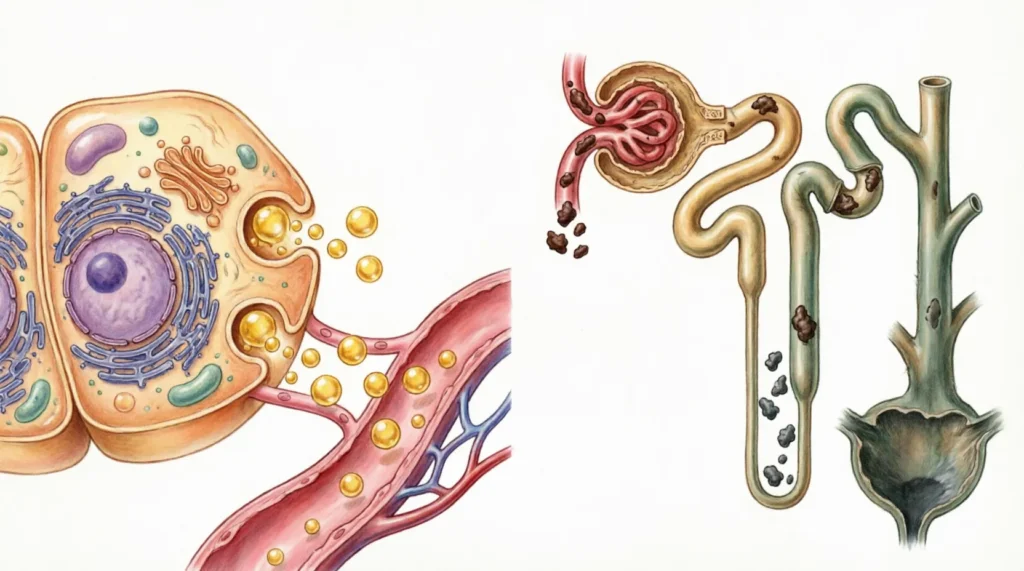
Quick answer: Secretion is the purposeful release of useful substances (like enzymes, hormones, or mucus) by cells or glands for a specific physiological function. Excretion is the removal of metabolic waste products (like urea, carbon dioxide, or sweat) that are toxic or unnecessary to the body. One builds and maintains; the other cleans and disposes.
Students and biology enthusiasts often conflate these two terms because both involve the movement of materials out of a cell or organism. However, confusing secretion with excretion is like confusing a chef plating a meal with a janitor taking out the trash. While the physical act of “letting something out” looks similar, the biological intent, the nature of the substance, and the ultimate destination are fundamentally different. Understanding this distinction is critical for grasping how organisms maintain homeostasis, digest food, and communicate internally.
| Term | Meaning / When to use | Example sentence |
|---|---|---|
| Secretion | The production and release of a useful substance by a gland or cell for a specific function within or outside the body. | The pancreas aids digestion through the secretion of insulin and digestive enzymes. |
| Excretion | The process of eliminating metabolic waste products from the body to prevent toxicity and maintain internal balance. | The kidneys are vital organs responsible for the excretion of urea and excess salts via urine. |
When to Use Secretion
Use the term secretion when you are describing the active, energy-consuming process where a cell or gland synthesizes and releases a substance that has a specific, beneficial job to do. These substances are not waste; they are tools. They might be used for communication (hormones), protection (mucus), or chemical breakdown (enzymes).
In biological contexts, secretion is often a highly regulated process. It requires the cell to package the material into vesicles and transport it to the membrane for release. According to Wikipedia, secretion is a mechanism found in all living cells, from single-celled bacteria releasing toxins to complex human glands releasing tears.
Here are three concrete examples of how to correctly use “secretion” in context:
- Endocrine Function: “The thyroid gland regulates metabolism through the secretion of thyroxine, a hormone that controls how quickly the body uses energy.”
- Digestive Process: “When you smell fresh bread, your salivary glands begin the secretion of amylase, an enzyme that starts breaking down starches even before you take a bite.”
- Protective Barrier: “The respiratory tract relies on the continuous secretion of mucus to trap dust particles and pathogens before they can reach the lungs.”
Notice that in every instance, the substance being released serves a constructive purpose. It is part of the body’s operational toolkit. If you are writing about a substance that helps the body function, communicate, or protect itself, you are talking about secretion.
When to Use Excretion
Use the term excretion when you are describing the passive or active removal of waste products generated by metabolic processes. These substances are byproducts of life that the body cannot use and, if allowed to accumulate, would become toxic. Excretion is primarily about disposal and maintaining the internal chemical environment (homeostasis).
The key here is “metabolic waste.” This includes nitrogenous wastes like urea and ammonia, carbon dioxide from respiration, and excess water and salts. The concept of difference is crucial here: while secretion adds value to the system, excretion removes liability.
Here are three concrete examples of how to correctly use “excretion” in context:
- Renal Function: “Patients with kidney failure require dialysis because their bodies can no longer handle the excretion of nitrogenous wastes, leading to a dangerous buildup of toxins in the blood.”
- Respiratory Waste: “While we often think of excretion only in terms of urine, the lungs play a major role in the excretion of carbon dioxide, a waste product of cellular respiration.”
- Thermoregulation and Waste: “Sweat glands contribute to the excretion of small amounts of urea and salts, although their primary function is cooling the body through evaporation.”
If you are writing about getting rid of something the body doesn’t want—something that is a byproduct of burning fuel, building muscle, or processing protein—you are talking about excretion. It is the biological equivalent of taking out the recycling and trash bins.
How to Remember the Difference
The easiest way to keep these two straight is to look at the root of the words and associate them with their ultimate fate.
Secretion comes from the Latin secernere, meaning “to separate” or “to set aside.” Think of it as setting aside something valuable for later use. A secretary keeps records and organizes important documents; a gland secretes important chemicals. Both are keeping things organized and useful.
Excretion comes from the Latin excernere, meaning “to sift out” or “to discharge.” The prefix “ex-” means “out.” Think of “exit.” Waste exits the body. It is gone. It is not coming back.
The Editor’s Trick: Ask yourself: “Is this substance a tool or a trash?”
- If it is a tool (enzyme, hormone, milk, sweat for cooling, mucus for trapping), it is Secretion.
- If it is trash (urea, CO2, feces, excess water), it is Excretion.
Another helpful mnemonic is: Secretion is for Service (it serves a function). Excretion is for Elimination (it eliminates waste).
Common Mistakes and Exceptions
Even among advanced students, certain biological processes blur the lines, leading to common errors. Here are the most frequent pitfalls and how to navigate them.
1. Sweat: Secretion or Excretion?
This is the most common point of confusion. Sweat is technically both, but the classification depends on the primary function being discussed.
- As Excretion: Sweat contains urea, salts, and ammonia. When discussing the removal of these metabolic wastes, sweat is an excretory product.
- As Secretion: The primary purpose of sweating is thermoregulation (cooling the body). The sweat glands are actively secreting a fluid to serve a physiological function.
- The Verdict: In most general biology contexts, sweat glands are classified as exocrine glands because they secrete their product onto an epithelial surface. However, the act of removing urea via sweat is excretion. Be precise: “Sweat glands secrete fluid for cooling, which also facilitates the excretion of minor metabolic wastes.”
2. Feces: Not Strictly Excretion
A major mistake in introductory biology is labeling defecation as excretion. Technically, feces are mostly undigested food matter, bacteria, and dead cells that never entered the body’s metabolic pathways. True excretion involves waste produced by cells during metabolism (like urea from protein breakdown).
- Correction: Defecation is egestion or elimination, not true excretion. The liver excretes bile pigments (waste from broken-down red blood cells) into the intestine, which then leave with feces, but the bulk of fecal matter is not metabolic waste.
3. US vs. UK Spelling
There is no difference in spelling for these specific terms between American and British English. Both use secretion and excretion. However, be careful with related terms. For example, the verb “practice” is spelled “practise” in British English when used as a verb, but this does not apply to our target keywords. Stick to the standard “-tion” ending for both.
4. “Exocrine” vs. “Endocrine”
Do not confuse the type of gland with the process.
- Exocrine glands secrete substances onto an epithelial surface (e.g., sweat glands, salivary glands).
- Endocrine glands secrete hormones directly into the bloodstream.
- Both are forms of secretion. Neither is inherently “excretion,” although the substances they release may eventually be excreted after they have served their purpose.
Frequently Asked Questions
Is urine secretion or excretion? Urine is the primary product of excretion. It contains water, urea, and salts that the body needs to eliminate to maintain chemical balance. The kidneys filter these wastes from the blood and excrete them as urine.
Are tears considered secretion or excretion? Tears are a form of secretion. They are produced by lacrimal glands to lubricate the eye, wash away debris, and provide antimicrobial protection. While they remove some irritants, their primary role is protective and functional, not waste disposal.
Why is carbon dioxide considered an excretory product? Carbon dioxide is a waste product of cellular respiration, the metabolic process that generates energy in cells. Because it is toxic in high concentrations and is a byproduct of metabolism, its removal via the lungs is classified as excretion.
Can a single organ perform both secretion and excretion? Yes. The liver is a prime example. It secretes bile, which helps digest fats (a useful function). It also processes hemoglobin waste into bilirubin, which is then excreted via bile into the intestines. Thus, the liver participates in both processes simultaneously.

Kevin Sanchez holds a Master’s degree in English Linguistics from the University of California, where he cultivated a deep appreciation for the intricacies of language. With over 10 years of experience in the field, Kevin specializes in the nuances of English spelling, particularly the evolution of spelling conventions over time. His fascination with how English words have transformed through cultural and technological influences led him to become a prominent voice at SpellRightDaily. Kevin produces content focused on historical spelling variations and their contemporary implications, offering readers insightful comparisons of British and American English. Beyond this, Kevin has a keen interest in educating readers about the rules that govern standard spelling and the exceptions that often lead to confusion. His articles frequently feature tips for mastering complex spelling patterns and understanding the etymology of perplexing words. Kevin’s dedication to clarity and accessibility makes his contributions invaluable to both casual readers and English language professionals.