

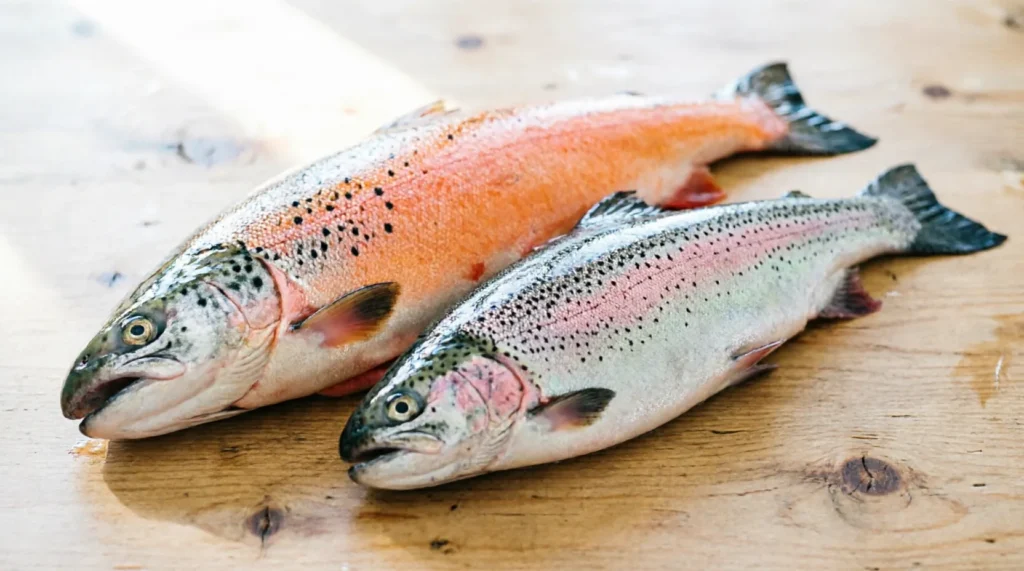
Quick answer: Steelhead are not a separate species from salmon; they are anadromous rainbow trout (Oncorhynchus mykiss) that migrate to the ocean, while “salmon” refers to several distinct species in the Oncorhynchus and Salmo genera. The primary difference is taxonomic classification and life history, not just appearance or taste.
Many anglers and seafood enthusiasts confuse steelhead with salmon because they look similar, inhabit the same rivers, and share a migratory lifestyle. Both fish are silvery when they return from the ocean, both fight hard on the line, and both are prized for their culinary value. However, understanding the biological distinction between these two fish is crucial for proper identification, conservation efforts, and accurate culinary labeling. While they may seem interchangeable in casual conversation, the difference between salmon and steelhead is rooted in genetics, taxonomy, and specific life cycle patterns that set them apart as distinct biological entities.
| Term | Meaning / When to use | Example sentence |
|---|---|---|
| Salmon | Refers to specific species in the Oncorhynchus (Pacific) or Salmo (Atlantic) genera that typically die after spawning (Pacific) or can spawn multiple times (Atlantic). | “We grilled fresh Atlantic salmon with lemon and dill for dinner.” |
| Steelhead | Refers specifically to the anadromous form of the rainbow trout (Oncorhynchus mykiss) that migrates to the ocean and returns to freshwater to spawn, often surviving to spawn again. | “The guide told us the river was full of steelhead running upstream to their natal grounds.” |
When to Use “Salmon”
You should use the term “salmon” when referring to members of the family Salmonidae that belong to the genera Oncorhynchus (Pacific salmon) or Salmo (Atlantic salmon). There are five primary species of Pacific salmon: Chinook (King), Coho (Silver), Sockeye (Red), Pink (Humpy), and Chum (Dog). Atlantic salmon (Salmo salar) is the only species in its genus found in the Atlantic Ocean.
The defining characteristic of most Pacific salmon is their semelparous life cycle, meaning they die after spawning once. This biological imperative drives their entire existence, from their ocean feeding phase to their final upstream journey. When you are discussing fish that exhibit this specific life history, or when you are referring to the commercial seafood industry’s standard offerings like Atlantic salmon fillets, “salmon” is the correct and precise term.
- “The Chinook salmon is the largest of the Pacific salmon species, often weighing over 30 pounds.”
- “Atlantic salmon farms produce the majority of the salmon consumed in the United States and Europe.”
- “Sockeye salmon are known for their deep red flesh and rich flavor profile.”
From an editorial perspective, I frequently see menus mislabeling trout as salmon to justify higher prices. If the fish is a rainbow trout that has never gone to sea, it is not steelhead, and it certainly is not salmon. Accuracy matters in both biology and commerce. the term Difference in biological classification is critical for understanding evolutionary relationships, and conflating these groups obscures their unique ecological roles.
When to Use “Steelhead”
Use the term “steelhead” exclusively when referring to the anadromous form of the rainbow trout (Oncorhynchus mykiss). Rainbow trout are native to North America and Asia, but only those populations that migrate to the ocean and return to freshwater to spawn are called steelhead. The name comes from their steely blue-green coloration when they return from the sea, which distinguishes them from the brighter, spotted appearance of resident rainbow trout.
Unlike Pacific salmon, steelhead are iteroparous, meaning they can survive spawning and return to the ocean to feed and grow before spawning again in subsequent years. This ability to spawn multiple times makes them biologically distinct from their Pacific salmon cousins, even though they share the same genus, Oncorhynchus. When you are fishing in a river on the West Coast of North America and catch a large, silvery trout that has been in the ocean, you have caught a steelhead, not a salmon.
- “The steelhead run in the Rogue River peaks in late winter and early spring.”
- “Because they can spawn multiple times, steelhead populations are managed differently than Pacific salmon.”
- “A resident rainbow trout and a steelhead are the same species, but their life histories differ dramatically.”
It is important to note that not all rainbow trout become steelhead. Only those that have access to the ocean and choose the migratory path earn the name. In many inland lakes and rivers, rainbow trout remain resident their entire lives, growing larger than their stream-bound counterparts but never acquiring the silvery marine phase. Understanding this distinction helps anglers appreciate the adaptability of Oncorhynchus mykiss. As noted in the detailed entry on Steelhead, the physiological changes these fish undergo during smoltification are remarkable adaptations for survival in saltwater.
How to Remember the Difference
The easiest way to remember the difference between salmon and steelhead is to focus on their taxonomy and life cycle resilience. Think of salmon as the “one-and-done” athletes of the fish world: they train in the ocean, make one epic journey upstream, spawn, and then pass away. Their entire biological program is geared toward a single reproductive event.
In contrast, think of steelhead as the “marathon runners” who can compete year after year. They are technically trout, not salmon, despite their size and migratory habits. A simple mnemonic is: “Salmon stop, Steelhead loop.” Pacific salmon stop at the end of their life cycle after spawning, while steelhead loop back to the ocean to recover and return again.
Another helpful trick is to look at the scientific names. If it starts with Salmo, it’s Atlantic salmon. If it’s Oncorhynchus and it’s one of the five Pacific species (Chinook, Coho, etc.), it’s salmon. If it’s Oncorhynchus mykiss and it’s been to the ocean, it’s a steelhead. Remembering that steelhead are actually rainbow trout in tuxedos can help clarify why they are not classified as true salmon.
Common Mistakes and Exceptions
One of the most common mistakes is calling any large, silvery fish a salmon. In the Pacific Northwest, anglers sometimes refer to steelhead as “salmon trout,” which is a colloquialism that muddies the waters. While they are related, steelhead are trout. Another frequent error is assuming that all trout are small and stay in freshwater. Steelhead can grow to impressive sizes, often exceeding 20 pounds, which leads to confusion with smaller salmon species like Pink or Chum.
There are also regional naming conventions that can cause confusion. In some parts of the world, the term “trout” is reserved for Salmo trutta (brown trout) and Salvelinus (char), while Oncorhynchus mykiss is always called rainbow trout or steelhead. However, in scientific contexts, the lines are drawn by genetics.
An exception to the “salmon die after spawning” rule is the Atlantic salmon. Unlike their Pacific relatives, Atlantic salmon can survive spawning and return to the sea, similar to steelhead. This is a key distinction that often trips people up. If you are talking about Atlantic salmon, you cannot assume they die after spawning. However, they are still classified as salmon, not steelhead, because they belong to the genus Salmo, not Oncorhynchus.
I once reviewed a nature documentary script that claimed steelhead were a type of Chinook salmon. This is biologically impossible. Chinook are Oncorhynchus tshawytscha, while steelhead are Oncorhynchus mykiss. They are cousins, not siblings. Such errors undermine the credibility of educational content and mislead the public about conservation needs. Steelhead face different threats than salmon, particularly regarding habitat fragmentation in freshwater systems where they need to survive multiple years, not just one.
Frequently Asked Questions
Is steelhead just a big rainbow trout? Yes, steelhead are genetically identical to rainbow trout; the only difference is that steelhead migrate to the ocean and return to freshwater to spawn, while resident rainbow trout stay in freshwater their entire lives.
Do steelhead taste like salmon? Steelhead have a flavor and texture that is very similar to salmon, often described as a mild, less oily version of salmon, which is why they are popular in culinary applications despite being trout.
Can you tell the difference between a steelhead and a salmon by looking at them? It can be difficult, but steelhead usually have a more prominent lateral line and smaller scales than salmon, and they retain their spots on the tail and back even when silvery, whereas most salmon lose their spots when they enter freshwater to spawn.
Why are steelhead not considered salmon if they go to the ocean? Taxonomy is based on genetics and evolutionary history, not just behavior; steelhead belong to the trout lineage (Oncorhynchus mykiss), while salmon belong to distinct species within the Oncorhynchus and Salmo genera, making them biologically different groups.

Kevin Sanchez holds a Master’s degree in English Linguistics from the University of California, where he cultivated a deep appreciation for the intricacies of language. With over 10 years of experience in the field, Kevin specializes in the nuances of English spelling, particularly the evolution of spelling conventions over time. His fascination with how English words have transformed through cultural and technological influences led him to become a prominent voice at SpellRightDaily. Kevin produces content focused on historical spelling variations and their contemporary implications, offering readers insightful comparisons of British and American English. Beyond this, Kevin has a keen interest in educating readers about the rules that govern standard spelling and the exceptions that often lead to confusion. His articles frequently feature tips for mastering complex spelling patterns and understanding the etymology of perplexing words. Kevin’s dedication to clarity and accessibility makes his contributions invaluable to both casual readers and English language professionals.