

Quick answer: The Smoky Mountains are a specific subrange located on the Tennessee-North Carolina border, while the Blue Ridge Mountains are the much larger parent province that stretches all the way from Pennsylvania to Georgia. You use “Smoky” for the national park; you use “Blue Ridge” for the broader mountain system and the scenic parkway.
I see this geographic mix-up constantly in travel manuscripts, tourism copy, and real estate listings. Writers routinely use “Smoky Mountains” and “Blue Ridge Mountains” as if they are interchangeable synonyms for the exact same Appalachian destination. In reality, one is a small, highly specific subrange, and the other is a massive geologic province that contains it.
| Term | Meaning / When to use | Example sentence |
|---|---|---|
| Smoky Mountains | Use when referring specifically to the subrange on the TN/NC border, home to the national park. | “We are driving to the Smoky Mountains this weekend to see the fall foliage.” |
| Blue Ridge Mountains | Use when referring to the entire geologic province stretching from PA to GA, or the scenic parkway. | “The Blue Ridge Mountains offer some of the oldest exposed rock in North America.” |
When to use Smoky Mountains
You should use “Smoky Mountains” exclusively when you are talking about the specific subrange located along the Tennessee and North Carolina border. This is the area that houses Great Smoky Mountains National Park, which is the most visited national park in the United States.
According to Smoky, the term often refers specifically to the Great Smoky Mountains, a subrange of the Blue Ridge that is famous for its dense, fog-like mist. If your copy mentions Gatlinburg, Cherokee, Clingmans Dome, or the national park itself, you must use “Smoky Mountains.”
Here are three real-world examples of how I correct this error in professional writing, showing the mistake and the proper fix.
- Email error: “I am heading to the Smoky Mountains in Virginia this weekend for a hiking trip.”
- Email fix: “I am heading to the Blue Ridge Mountains in Virginia this weekend for a hiking trip.” (Virginia does not contain the Smokies).
- Resume error: “Directed marketing for a tourism board covering the Smoky Mountains of Pennsylvania.”
- Resume fix: “Directed marketing for a tourism board covering the Blue Ridge Mountains of Pennsylvania.” (Again, the Smokies do not extend to Pennsylvania).
- Text message error: “Can’t wait for our trip to the Great Blue Ridge Mountains National Park!”
- Text message fix: “Can’t wait for our trip to the Great Smoky Mountains National Park!” (The park is officially named after the Smokies, not the Blue Ridge).
Using “Smoky Mountains” outside of this specific geographic boundary instantly signals to local readers that you do not know the area. It is the equivalent of calling all of California “Los Angeles.” Keep your geography tight and your terminology precise.
When to use Blue Ridge Mountains
You should use “Blue Ridge Mountains” when referring to the massive geologic province that forms the easternmost range of the Appalachian Mountains. This system stretches over 600 miles, starting in southern Pennsylvania and ending in northern Georgia.
As noted in the broader geological context of Mountains, ranges are often classified into larger provinces based on shared tectonic history, which is exactly how the Blue Ridge functions as a parent system. If your copy mentions Shenandoah National Park, Skyline Drive, Asheville, Roanoke, or the Blue Ridge Parkway, you must use “Blue Ridge Mountains.”
The Blue Ridge is the umbrella term. It encompasses dozens of smaller subranges, including the Smokies, the Great Balsams, and the Unaka Mountains. When you are writing about the broader Appalachian experience, the scenic byway, or the geologic history of the eastern United States, “Blue Ridge Mountains” is your correct term.
Here is how this applies in everyday professional contexts.
- Email: “Our Q3 executive retreat will be held at a conference center in the Blue Ridge Mountains.”
- Resume: “Authored a 50-page guidebook on the hiking trails of the Blue Ridge Mountains.”
- Text message: “The Blue Ridge Mountains look incredibly purple in the evening light.”
Notice how the Blue Ridge applies to a much wider variety of locations. If you are north of Knoxville or south of Atlanta, you are almost certainly in the Blue Ridge Mountains, but you are definitely not in the Smoky Mountains.
How to remember the difference
The easiest way to remember this distinction is to use what I call the “Matryoshka doll” rule. The Smoky Mountains are literally inside the Blue Ridge Mountains.
Think of the Blue Ridge as the large outer doll. It represents the entire 600-mile chain. The Smoky Mountains are the small inner doll. They are a tiny, specific piece of the larger whole. If you are talking about the whole, use Blue Ridge. If you are talking about the specific piece, use Smoky.
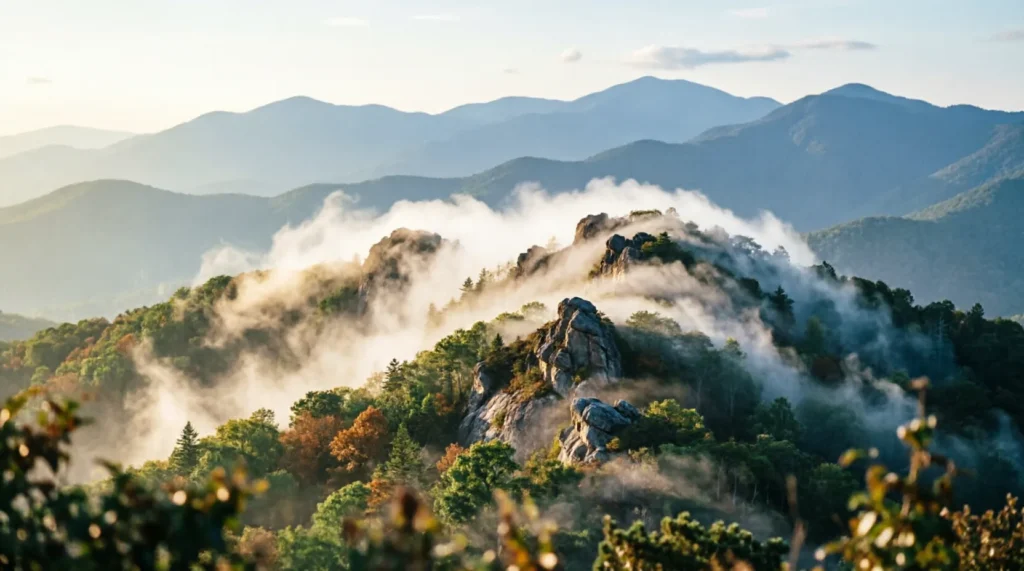
You can also use a visual memory trick based on the names themselves. The word “Smoky” refers to the thick, white, fog-like mist that hangs specifically over the high peaks of the Tennessee-North Carolina border. The word “Blue” refers to the distant, hazy blue tint that the entire massive mountain chain takes on when viewed from far away.
Here is an editor-level insight that will save you from making this mistake in your own writing. When you are fact-checking a travel manuscript, open a map and look at the Blue Ridge Parkway. The parkway runs for 469 miles through the broader Blue Ridge Mountains. It specifically bypasses the highest, most rugged peaks of the Smoky Mountains to the east. If the text claims the parkway goes through the Smokies, it is geographically incorrect.
Common mistakes and exceptions
Even with the Matryoshka doll rule in mind, writers still fall into a few common traps. I want to highlight the most frequent errors I catch during the editing process so you can avoid them entirely.
The first major mistake is using “the Smokies” to refer to any mountain in the Appalachian chain. I frequently read blog posts that say, “We took a beautiful drive through the Smokies in Virginia.” This is factually wrong. The mountains in Virginia are part of the Blue Ridge. Using “Smokies” as a catch-all term for the entire Appalachian range is a dead giveaway of an inexperienced travel writer.
The second mistake involves capitalization. “Smoky Mountains” and “Blue Ridge Mountains” are proper nouns. They must always be capitalized. I constantly see drafts that refer to “the smoky mountains” or “the blue ridge mountains” in lowercase. Unless you are literally talking about mountains that are blue or mountains that are smoky in a poetic, descriptive sense, you must capitalize them as geographic names.
The third mistake involves the word “Great.” The official name of the national park is Great Smoky Mountains National Park. However, it is perfectly acceptable to refer to the geographic region simply as the “Smoky Mountains.” You do not need to force the word “Great” into every sentence. In fact, overusing “Great” can make your copy sound repetitive and unnatural.
The fourth mistake is confusing the Blue Ridge Parkway with the Smoky Mountains. The parkway connects Shenandoah National Park to the Great Smoky Mountains National Park, but it does not actually enter the Smokies. It ends at the edge of the park in Cherokee, North Carolina. If your copy says the parkway winds through the Smokies, you need to rewrite that sentence.
Frequently Asked Questions
Are the Smoky Mountains part of the Blue Ridge Mountains? Yes, the Smokies are a distinct subrange located entirely within the broader Blue Ridge Mountains province. They are a subset of the larger system, not a separate geologic entity.
Is the Blue Ridge Parkway in the Smoky Mountains? No, the Blue Ridge Parkway primarily traverses the broader Blue Ridge Mountains, bypassing the highest peaks of the Smokies to the east. It ends at the boundary of the Great Smoky Mountains National Park but does not enter it.
Why are they called the Smoky Mountains? The name comes from the natural blue-green fog that hangs over the specific subrange, making it look perpetually smoky. This mist is created by the dense vegetation releasing volatile organic compounds into the air.
Can I just say “the Smokies” in formal writing? In formal travel copy, academic writing, or official park documentation, I always spell out “Smoky Mountains” to maintain a professional tone. However, “the Smokies” is perfectly acceptable in casual blogs, text messages, and conversational prose.

Kevin Sanchez holds a Master’s degree in English Linguistics from the University of California, where he cultivated a deep appreciation for the intricacies of language. With over 10 years of experience in the field, Kevin specializes in the nuances of English spelling, particularly the evolution of spelling conventions over time. His fascination with how English words have transformed through cultural and technological influences led him to become a prominent voice at SpellRightDaily. Kevin produces content focused on historical spelling variations and their contemporary implications, offering readers insightful comparisons of British and American English. Beyond this, Kevin has a keen interest in educating readers about the rules that govern standard spelling and the exceptions that often lead to confusion. His articles frequently feature tips for mastering complex spelling patterns and understanding the etymology of perplexing words. Kevin’s dedication to clarity and accessibility makes his contributions invaluable to both casual readers and English language professionals.