

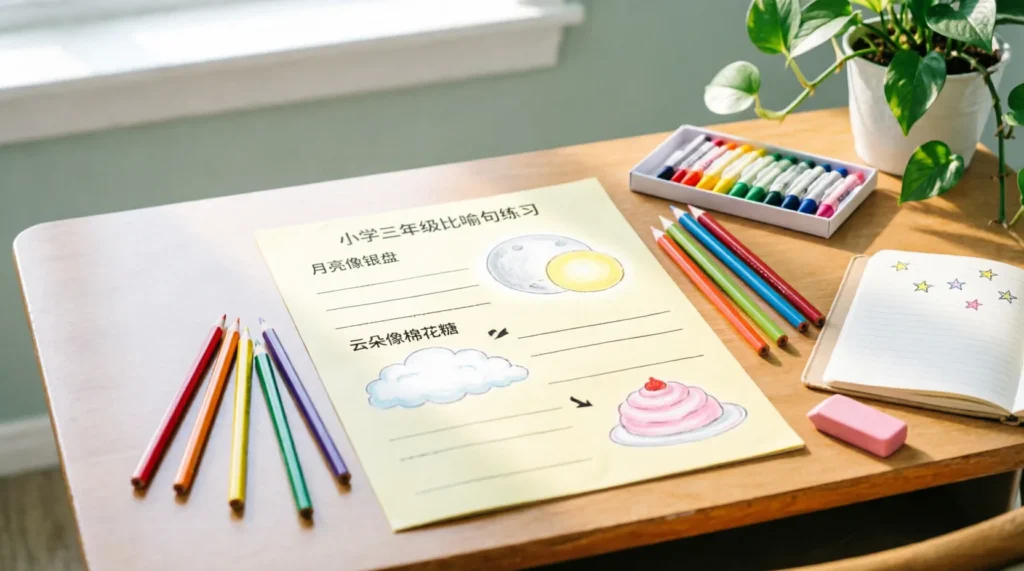
Quick answer: A similes worksheet for class 3 is a structured educational tool designed to help eight- and nine-year-old students identify, understand, and create comparisons using “like” or “as.” These worksheets bridge the gap between literal and figurative language, providing essential practice for young learners to enhance their descriptive writing skills.
Teaching figurative language to third graders can feel like trying to explain color to someone who has only seen black and white. Children at this age are deeply rooted in literal thinking. They know what a cat is, and they know what a tiger is, but connecting the two through the phrase “brave as a tiger” requires a cognitive leap. This is where a well-designed similes worksheet for class 3 becomes indispensable. It provides the scaffolding necessary for students to move beyond basic sentence structures and begin painting pictures with words.
The confusion often arises because young writers tend to overuse basic adjectives. Instead of saying a character was “scared,” they might struggle to express how scared. A simile offers a shortcut to vivid description. By mastering these comparisons early, students build a foundation for more complex literary devices they will encounter in later grades, such as metaphors and personification.
| Term | Meaning / When to use | Example sentence |
|---|---|---|
| Simile | A figure of speech that directly compares two different things using the words “like” or “as.” Use it to make descriptions more vivid and relatable. | The clouds floated across the sky like cotton balls. |
| Metaphor | A figure of speech that describes an object or action in a way that isn’t literally true, but helps explain an idea or make a comparison without using “like” or “as.” | The classroom was a zoo during recess. |
| Literal Language | Words used in their exact, dictionary-defined sense. Use this for factual statements and clear instructions. | The dog barked loudly at the mail carrier. |
When to use “Like” in Similes
The word “like” is the most common connector in similes for third-grade students. It is intuitive and easy to spot. I often tell my students that “like” acts as a bridge between two separate ideas. You use “like” when you want to say that one thing resembles another in a specific way.
For example, if a student wants to describe how fast their friend runs, they might say, “He runs fast.” This is accurate but boring. Using a simile worksheet for class 3, they can practice transforming that sentence into, “He runs like the wind.” This instantly creates a mental image of speed and invisibility.
Here are three concrete examples of how “like” functions in student writing:
- Describing texture: “The kitten’s fur felt soft like silk.” (Instead of just saying “soft.”)
- Describing sound: “The thunder crashed like a drum set falling down the stairs.” (Instead of just saying “loud.”)
- Describing behavior: “My little brother eats like a hungry wolf.” (Instead of just saying “quickly” or “messily.”)
When teaching this, emphasize that the two things being compared must be different in nature. Saying “The apple looks like a fruit” is not a simile; it is a classification. Saying “The apple shines like a ruby” is a simile because an apple and a gemstone are fundamentally different objects that share a visual trait.
When to use “As” in Similes
While “like” is versatile, “as” is typically used in a specific structure: “as [adjective] as [noun].” This pattern is slightly more rigid but incredibly powerful for creating rhythmic and memorable phrases. Many classic similes use this structure, making it easier for children to memorize and recall.
I see this error constantly in early drafts: students will mix the structures, saying “He is strong like a lion” when they might mean “He is as strong as a lion.” Both are grammatically correct similes, but the “as… as” structure emphasizes the degree of the adjective. It suggests equality in that specific trait.
Consider these examples from typical third-grade compositions:
- Describing height: “The giraffe was as tall as a telephone pole.”
- Describing cleanliness: “After the bath, the puppy was as clean as a whistle.”
- Describing lightness: “The feather fell as lightly as a snowflake.”
Worksheets often focus on completing these “as… as” phrases because they provide a clear template for students who are struggling to start. By giving them the first half (“as busy as…”), you allow them to focus solely on selecting an appropriate noun (“…a bee”) without worrying about sentence structure.
How to remember the difference
The biggest hurdle for third graders is remembering that similes must use “like” or “as.” If those words are missing, it is not a simile. To help students lock this rule into their memory, I use a simple mnemonic device: S.L.A.S.
Similes
Like
And
Sas
You can visualize this as a pair of glasses. The “L” and the “S” are the lenses. Without them, you cannot see the comparison clearly. Another effective trick is the “Bridge Method.” Draw two islands on a piece of paper. Label one island “Thing A” and the other “Thing B.” Draw a bridge between them. Write “LIKE” or “AS” on the bridge. Explain to the students that you cannot get from one idea to the other without crossing the bridge. If the bridge is missing, the sentence falls into the water.
This visual aid works wonders during interactive whiteboard sessions. When a student writes, “The sun was a gold coin,” I ask them, “Where is the bridge?” They quickly realize they need to add “like” or “as” to complete the simile. This tactile approach reinforces the structural requirement of the device.
Common mistakes and exceptions
Even with practice, third graders fall into several common traps. Understanding these pitfalls allows teachers and parents to provide targeted feedback. The most frequent mistake is confusing similes with metaphors. As noted in educational resources, a simile explicitly uses comparative words, whereas a metaphor states that one thing is another. A student might write, “Her eyes were stars.” This is a metaphor. To make it a simile, it must be, “Her eyes sparkled like stars.”
Another common error is using clichés without understanding them. Phrases like “cold as ice” or “fast as lightning” are so common that students use them automatically. While these are technically correct similes, they do not demonstrate creative thinking. A high-quality similes worksheet for class 3 should encourage students to move beyond these overused comparisons. Ask them: “Can you think of something else that is cold? Maybe a popsicle? Maybe a penguin’s tummy?”
There are also regional differences in language instruction, though the core definition of a simile remains constant. In some curricula, the distinction between similes and analogies is blurred at this age. However, for third grade, it is best to keep the focus strictly on “like” and “as.” Introducing complex analogies too early can confuse the basic concept.
Additionally, students often struggle with illogical comparisons. For example, “He runs like a table.” This fails because tables do not run. A good editor—or teacher—must point out that the comparison must make sense in terms of the trait being described. A table is sturdy, so “He stands as still as a table” would work. But for running, you need a noun that implies motion.
Frequently Asked Questions
What is the main purpose of a similes worksheet for class 3? The primary purpose is to help students recognize and create figurative language, enhancing their descriptive writing skills by moving beyond literal adjectives.
Can a simile use words other than “like” or “as”? No, by definition, a simile must use “like” or “as” to make the comparison explicit; otherwise, it becomes a metaphor or another figure of speech.
How many similes should a third grader know? There is no fixed number, but students should be comfortable identifying and creating at least 5-10 original similes by the end of the year to demonstrate mastery.
Are there printable resources available for these worksheets? Yes, many educational websites offer free and paid printable worksheets that include exercises for identifying, completing, and creating similes tailored to third-grade reading levels.

Kevin Sanchez holds a Master’s degree in English Linguistics from the University of California, where he cultivated a deep appreciation for the intricacies of language. With over 10 years of experience in the field, Kevin specializes in the nuances of English spelling, particularly the evolution of spelling conventions over time. His fascination with how English words have transformed through cultural and technological influences led him to become a prominent voice at SpellRightDaily. Kevin produces content focused on historical spelling variations and their contemporary implications, offering readers insightful comparisons of British and American English. Beyond this, Kevin has a keen interest in educating readers about the rules that govern standard spelling and the exceptions that often lead to confusion. His articles frequently feature tips for mastering complex spelling patterns and understanding the etymology of perplexing words. Kevin’s dedication to clarity and accessibility makes his contributions invaluable to both casual readers and English language professionals.