

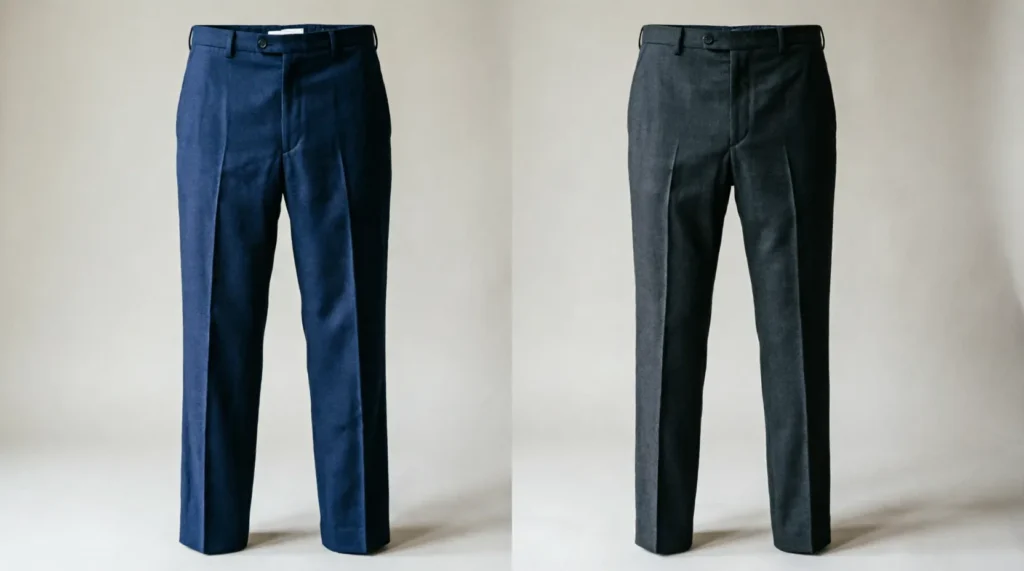
Quick answer: Tailored trousers are custom-fitted to your exact measurements with a structured silhouette, while slim fit trousers are a ready-to-wear cut that sits close to the body but follows standard sizing. Choose tailored for a personalized fit; choose slim fit for a modern, close-cut look off the rack.
If you’ve stood in a clothing store staring at two pairs of pants wondering which will actually look good on you, you’re not alone. The terms “tailored” and “slim fit” get thrown around interchangeably in menswear, but they describe fundamentally different approaches to how trousers fit your body. Understanding the distinction saves you money, prevents wardrobe mistakes, and ensures you look sharp whether you’re dressing for a boardroom or a wedding.
| Term | Meaning / When to use | Example sentence |
|---|---|---|
| Tailored | Custom-made or altered to fit your specific body measurements; implies personalized construction and precise fit | “I had my wedding trousers tailored to ensure the break hit perfectly at my shoes.” |
| Slim fit | A standardized cut that sits close to the body with narrower legs and a tapered silhouette; available off-the-rack | “He bought slim fit trousers from the department store for his new job interview.” |
When to use tailored
Use “tailored” when you’re describing trousers that have been custom-made or professionally altered to match your exact body measurements. This isn’t just about size—it’s about proportion, posture, and personal preference. A truly tailored pair of trousers accounts for your hip height, thigh circumference, inseam length, and even how you stand.
I’ve edited countless fashion copy and style guides, and the mistake I see constantly is people using “tailored” to mean “fitted” or “slim.” That’s incorrect. Tailored means a professional has worked on the garment specifically for you.
Real-world examples:
- Email to a tailor: “Hi James, I need my charcoal trousers tailored—the waist is perfect but the legs are too wide for my preference.”
- Resume/CV line: “Commissioned tailored trousers for client presentations, ensuring professional appearance and confidence.”
- Text to a friend: “Just picked up my tailored trousers from the shop—they finally fit my weird hip-to-waist ratio perfectly.”
According to Wikipedia’s entry on tailored clothing, the practice involves creating garments to fit an individual’s unique measurements rather than relying on standardized sizing. This is why tailored trousers cost more: you’re paying for expertise, time, and a fit that mass-produced clothing simply cannot achieve.
Choose tailored when:
- You have an unusual body proportion (long torso, short legs, athletic build with narrow waist)
- You need trousers for a once-in-a-lifetime event like a wedding
- You want trousers that will last years and maintain their shape
- You’re investing in a capsule wardrobe where every piece must be perfect
When to use slim fit
Use “slim fit” when you’re describing a specific cut of ready-to-wear trousers that sits close to the body with a narrower leg opening and tapered silhouette from hip to ankle. Slim fit is a style category, not a customization process. These trousers come in standard sizes (32×32, 34×30, etc.) but are cut differently than regular or relaxed fit options.
Slim fit has dominated menswear for the past 15 years, replacing the baggy, pleated styles of the 1990s and early 2000s. However, “slim” doesn’t mean “skinny”—there’s still room for movement and comfort, just less excess fabric.
Real-world examples:
- Shopping online: “Adding slim fit trousers in navy to cart—size 32 waist, 32 inseam.”
- LinkedIn bio: “Professional wardrobe built on slim fit trousers and tailored blazers for a modern, polished look.”
- Text message: “Can’t find slim fit trousers that don’t hug my thighs too tight—any brand recommendations?”
Choose slim fit when:
- You want a contemporary, modern silhouette without custom tailoring costs
- You have a relatively standard body type that fits mainstream sizing
- You’re building a work wardrobe on a budget
- You prefer the aesthetic of clean lines and minimal fabric bunching
The key distinction: you can buy slim fit trousers off the rack, but you can also have slim fit trousers tailored. These aren’t mutually exclusive concepts—one describes the cut, the other describes the fitting process.
How to remember the difference
Here’s the memory trick I give every junior editor and style writer I train: Tailored = Time + Tailor. Slim fit = Store-bought shape.
If a tailor’s scissors touched it specifically for you, it’s tailored. If you grabbed it from a hanger in your size, it’s slim fit (or regular fit, or relaxed fit—whatever the cut).
Another way to think about it: “Tailored” is a verb-turned-adjective (someone tailored it). “Slim fit” is a noun phrase describing a style category (like “athletic fit” or “straight leg”).
When I’m proofreading menswear catalogs, I look for this specific error: brands claiming their off-the-rack slim fit trousers are “tailored.” That’s misleading marketing. They might be “tailored-style” or “inspired by tailored clothing,” but unless a human being measured you and adjusted the pattern, they’re not actually tailored.
Common mistakes and exceptions
Mistake #1: Using “tailored” as a synonym for “fitted” or “slim”
This is the most common error I catch in fashion writing. A garment can be slim fit without being tailored. A garment can be tailored without being slim fit (you could have tailored wide-leg trousers, for example). These are separate concepts.
Mistake #2: Assuming slim fit is always better for thin people
I see this constantly in style advice columns. Slim fit isn’t automatically flattering for slender builds—if the proportions are wrong, slim fit trousers can make you look like you’re wearing your little brother’s clothes. Sometimes a tailored regular fit looks infinitely better than an ill-fitting slim cut.
Mistake #3: Thinking tailored means expensive bespoke only
While bespoke (made from scratch) is the pinnacle of tailoring, you can also get “made-to-measure” (adjusted from a base pattern) or simply take off-the-rack trousers to a tailor for alterations. All three count as tailored. I’ve had clients spend $80 on trousers and $40 on alterations, ending up with a better fit than $400 bespoke pants because the tailor understood their body.
Regional differences:
In British English, you’ll often hear “tailored trousers” used more broadly to mean any well-fitted, structured trouser, even if not custom-made. American English tends to be stricter—”tailored” implies actual alteration or custom work. When writing for international audiences, I always clarify: “tailored (custom-fitted)” on first use to avoid confusion.
The exception that proves the rule:
Some high-end ready-to-wear brands use “tailored” in their marketing to describe trousers with structured construction (darts, proper lining, quality waistbands) even though they’re not custom. This is technically incorrect but industry-standard. As a consumer, don’t be fooled—check if alterations are included or if it’s just marketing speak.
Frequently Asked Questions
Can slim fit trousers be tailored?
Absolutely. In fact, I recommend it—buying slim fit trousers and having them tailored to your exact measurements gives you the modern silhouette you want with the personalized fit you need. This is often more affordable than bespoke.
Are tailored trousers always slim fit?
No. Tailored simply means customized to your measurements. You can have tailored trousers in any cut—slim, regular, wide-leg, or pleated. The tailoring refers to the fitting process, not the style.
Which is better for a job interview: tailored or slim fit?
Choose tailored if you have the time and budget—it projects confidence and attention to detail. If you’re shopping last-minute, well-fitted slim fit trousers in a classic color (navy, charcoal, black) work perfectly. The fit matters more than the category.
How much should tailored trousers cost compared to slim fit off-the-rack?
Off-the-rack slim fit trousers range from $40-$300 depending on brand. Tailored trousers (including alterations) typically start around $150 and go up to $1,000+ for bespoke. The investment pays off in longevity and confidence, but slim fit is perfectly acceptable for most professional settings.

Anthony Perez, a PhD in Applied Linguistics from the University of Toronto, has dedicated over 12 years to studying the cognitive aspects of language acquisition, with a special focus on English spelling conventions. His journey into the world of spelling and word comparisons was sparked by his research on how non-native speakers adapt to English orthography. At SpellRightDaily, Anthony shares his insights through content that explores the science behind spelling acquisition and offers strategies for overcoming common traps in English spelling. His articles are particularly aimed at learners who are new to English, although his engaging explanations also attract native speakers interested in refining their spelling skills. Anthony’s research-driven approach provides an evidence-based perspective that enriches the site’s resources, offering readers not just the ‘how’ but the ‘why’ behind effective spelling strategies. His work at SpellRightDaily combines academic rigor with practical application, making complex concepts accessible to a broad audience.