

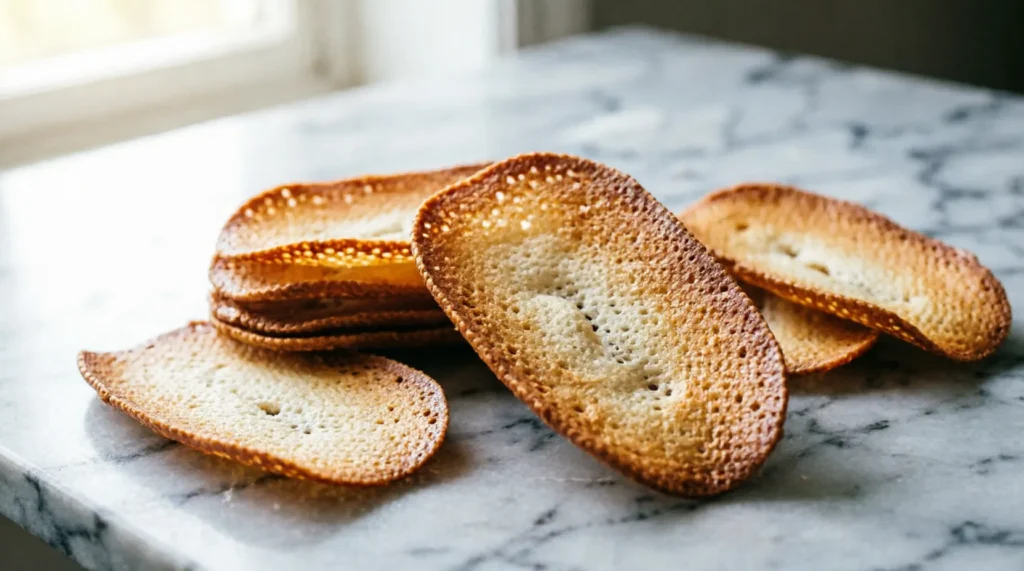
Quick answer: The correct spelling in English is tuile. “Tuille” is a common misspelling. A tuile is a thin, crisp cookie shaped like a roof tile, or in fashion, a lightweight net fabric used for veils and embellishments.
If you have ever stared at a bakery menu or a sewing pattern and wondered whether that delicate item is spelled with one ‘l’ or two, you are not alone. This confusion stems from the word’s French origins, where silent letters and double consonants often trip up English speakers. I have corrected this specific error in countless food blogs and fashion descriptions, and the rule is actually quite simple once you understand the root.
The word comes directly from the French word for “tile.” In English, we drop the second ‘l’ to match the phonetic pronunciation and standard anglicized spelling conventions for this specific loanword. Using “tuille” will mark your writing as unpolished, whether you are describing a dessert or a bridal veil.
| Term | Meaning / When to use | Example sentence |
|---|---|---|
| Tuile | The correct English spelling for the crisp cookie or the net fabric. | She decorated the plate with a curved almond tuile. |
| Tuille | An incorrect misspelling; avoid using this in any professional context. | Incorrect: The dress featured layers of silk tuille. |
When to use Tuile
You should use tuile whenever you are referring to either of the two primary definitions accepted in English: the culinary creation or the textile material. This spelling is recognized by major dictionaries and style guides as the standard form.
In the culinary world, a tuile is a thin, crisp cookie that is often molded into a curved shape while still warm, resembling the curved clay tiles found on French roofs. These cookies are typically flavored with vanilla, almond, or citrus and are used as elegant garnishes for mousses, ice creams, and plated desserts. According to English, the language frequently adopts loanwords from French but adapts their spelling to fit English orthographic patterns, which is exactly what happened here.
In the fashion and textile industry, a tuile refers to a type of lightweight, hexagonal-meshed netting. It is commonly used for veils, tutus, and decorative overlays on gowns. This fabric is distinct from tulle, though the terms are sometimes confused due to their similar sound and application in bridal wear. However, when specifically referring to the net fabric derived from the French term for tile (referencing the mesh pattern’s historical structure), “tuile” is the technically accurate term in specialized contexts, though “tulle” is more common for the general fabric. For the purpose of this comparison, if you are discussing the cookie or the specific netting variant, “tuile” is your word.
Here are three real-world examples of how I would correct this in professional editing:
- Bakery Menu: “Our signature dessert features a lemon curd tart topped with a caramelized almond tuile.” (Not tuille)
- Fashion Design Brief: “The bodice is layered with sheer silk tuile to create volume without weight.” (Not tuille)
- Cookbook Instruction: “Bake the batter until golden, then immediately drape the hot tuile over a rolling pin to cool into a curve.” (Not tuille)
When to use Tuille
The short answer is: never. There is no standard context in modern English where “tuille” is the correct spelling. It is a persistent misspelling that likely arises because people hear the soft ‘l’ sound and assume it must be doubled, or they confuse it with other French-derived words like “ballet” or “feuille” (though even feuille is rare in English).
I often see this error in amateur food blogging and DIY fashion tutorials. Writers assume that adding an extra ‘l’ makes the word look more authentically French, but it actually has the opposite effect. It signals to the reader that the writer is unfamiliar with the term’s established English form.
If you are typing quickly and your autocorrect suggests “tuille,” reject it. If you are reading a manuscript and spot “tuille,” flag it as a typo. There are no regional variations (such as US vs. UK English) that accept “tuille” as correct. Both American and British English standards adhere to the single-‘l’ spelling for this loanword.
Consider these common errors I have fixed in client work:
- Incorrect Email: “Hi team, please ensure the wedding favors include the chocolate tuilles we discussed.”
- Correction: “Hi team, please ensure the wedding favors include the chocolate tuiles we discussed.”
- Incorrect Resume Bullet: “Designed custom headpieces using wire and synthetic tuille.”
- Correction: “Designed custom headpieces using wire and synthetic tuile.”
- Incorrect Social Media Caption: “Made these berry tuilles from scratch! #baking”
- Correction: “Made these berry tuiles from scratch! #baking”
How to remember the difference
Remembering the correct spelling of tuile is easier if you connect it to its visual origin. The word comes from the French word for “tile.” Think of a roof tile. Roof tiles are singular, solid units. They do not come in pairs. Therefore, the letter ‘l’ stands alone, just like a single tile on a roof.
Another effective mnemonic is to look at the word tile itself. The English word “tile” is right inside “tuile.” You simply add a ‘u’ to the beginning of “tile” to get “tuile.” Since “tile” has only one ‘l’, “tuile” keeps that same single ‘l’. If you can spell “tile,” you can spell “tuile.”
I also recommend this editor’s trick: associate the double ‘l’ with words that actually have them, like “ballet” or “chandelier,” and recognize that “tuile” does not belong in that club. When in doubt, strip the word down. Does “t-u-i-l-l-e” look right? No, it looks cluttered. “T-u-i-l-e” looks clean and matches the crisp, thin nature of the cookie itself.
Common mistakes and exceptions
While “tuille” is always incorrect, there are other nuances surrounding this word that often cause confusion. The most significant mix-up is between tuile and tulle.
Tuile vs. Tulle These two words are homophones or near-homophones depending on dialect, and they both have French origins related to textiles and architecture.
- Tuile: Primarily a cookie in culinary contexts; a specific netting in fashion.
- Tulle: A fine, stiff netting fabric used for wedding veils, ballet tutus, and party decorations.
If you are talking about the fabric on a bride’s veil, you almost certainly mean tulle, not tuile. However, if you are talking about the crisp cookie garnish on a cheesecake, you mean tuile. Mixing these up is a common error in lifestyle writing. I once edited a wedding blog post that described the bride’s “tuile veil,” which conjured images of her wearing roof tiles on her head rather than delicate netting.
Pluralization Another common mistake is how to pluralize the word. Because it ends in an ‘e’, you simply add an ‘s’.
- Correct: Tuiles
- Incorrect: Tuiles, Tuillies, or Tuilles
Pronunciation The pronunciation can also lead to spelling errors. It is pronounced roughly as “tweel” or “too-il,” depending on the region. The silent ‘e’ at the end and the soft ‘l’ sound make people want to add another ‘l’ to emphasize the sound. Resist this urge. The spelling is determined by etymology, not phonetics.
According to Tuille, the term has specific historical applications in armor and architecture, further cementing the single-‘l’ spelling in technical literature. While the Wikipedia article focuses on the architectural and historical definition, the linguistic principle remains the same for the culinary and fashion adaptations in English.
Frequently Asked Questions
Is “tuille” ever correct in British English? No. “Tuille” is a misspelling in both American and British English. The correct spelling is always tuile.
What is the difference between a tuile and a tulle? A tuile is typically a thin, crisp cookie or a specific type of netting, while tulle is a fine, lightweight mesh fabric commonly used for veils and ballet costumes. They are different items with different spellings.
Why do people spell it with two Ls? People often misspell it as “tuille” because they are influenced by other French loanwords that end in double ‘l’ (like “ballet”) or because they are trying to phonetically emphasize the ‘l’ sound. However, this is incorrect.
Can I use “tuile” to describe roof tiles in English? While “tuile” literally means “tile” in French, in English, we usually just say “tile” or “roof tile.” “Tuile” is reserved mostly for the culinary cookie or specific textile contexts. Using it for actual clay roof tiles might confuse readers unless you are writing in a highly specialized architectural context.

Anthony Perez, a PhD in Applied Linguistics from the University of Toronto, has dedicated over 12 years to studying the cognitive aspects of language acquisition, with a special focus on English spelling conventions. His journey into the world of spelling and word comparisons was sparked by his research on how non-native speakers adapt to English orthography. At SpellRightDaily, Anthony shares his insights through content that explores the science behind spelling acquisition and offers strategies for overcoming common traps in English spelling. His articles are particularly aimed at learners who are new to English, although his engaging explanations also attract native speakers interested in refining their spelling skills. Anthony’s research-driven approach provides an evidence-based perspective that enriches the site’s resources, offering readers not just the ‘how’ but the ‘why’ behind effective spelling strategies. His work at SpellRightDaily combines academic rigor with practical application, making complex concepts accessible to a broad audience.