

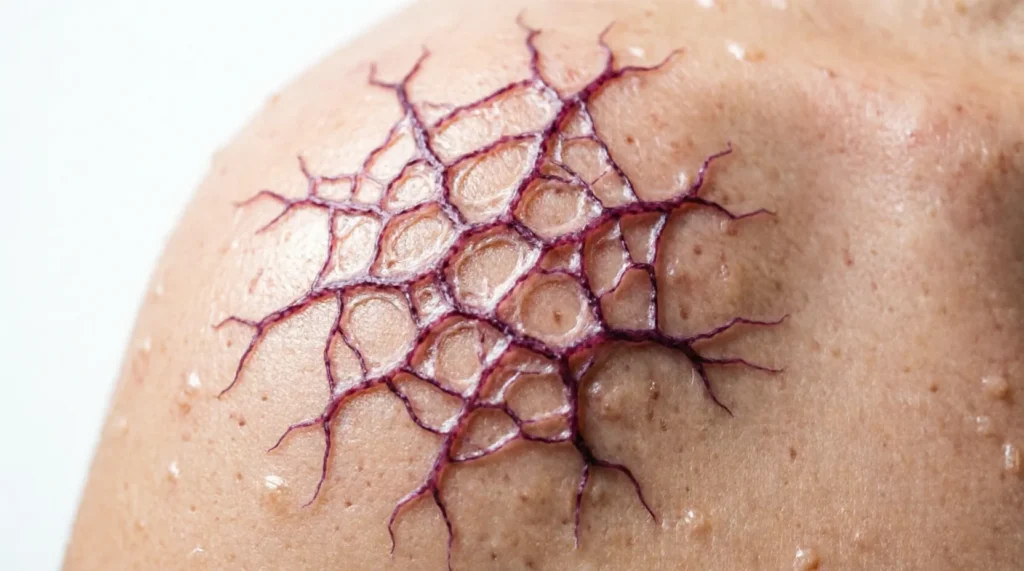
Quick answer: Use lacy when describing the visual appearance of a rash that looks like lacework, especially in patient-friendly communication. Use reticular when writing clinical documentation or discussing the underlying network-like structure of the lesion, as it is the precise medical terminology. Both are correct, but they serve different audiences and contexts.
Patients and even some healthcare providers often stumble over whether to describe a net-like skin pattern as “lacy” or “reticular.” The confusion stems from the fact that both words describe the same visual phenomenon: a web-like, net-shaped, or meshed appearance on the skin. However, choosing the wrong term can lead to miscommunication between patients and doctors, or make clinical notes appear unprofessional. Understanding the nuance between these two descriptors ensures clarity in both medical records and everyday health discussions.
| Term | Meaning / When to use | Example sentence |
|---|---|---|
| Lacy | Describes the visual aesthetic of a rash resembling lace fabric; best for patient education and general description. | “The patient presented with a lacy, purple discoloration on her lower legs.” |
| Reticular | Refers to the anatomical or structural network pattern; preferred in clinical diagnosis and medical literature. | “The biopsy confirmed a reticular pattern consistent with livedo reticularis.” |
When to use lacy
I have reviewed thousands of dermatology notes and patient intake forms, and I see “lacy” used most effectively when the goal is immediate visual recognition by a non-specialist. The word “lacy” evokes a specific texture and pattern that most people understand intuitively. It describes something that resembles lace fabric, which is characterized by open, woven patterns with holes and interconnected threads.
According to Wikipedia, the term relates to the intricate, openwork design typical of lace materials. In a medical context, this translates to skin lesions that form a net-like pattern with pale centers and darker borders. You should use “lacy” when speaking directly to patients, writing public health brochures, or documenting initial observations where the primary goal is to convey the visual look rather than the pathological structure.
Here are three real-world examples where “lacy” is the superior choice:
- Patient Email: “You mentioned noticing a lacy, reddish pattern on your thighs after being in the cold. This is likely a benign reaction called cutis marmorata.”
- Nursing Handoff: “The patient has a lacy rash on her back that blanches when pressed. It appeared after the fever broke.”
- Telehealth Triage Note: “User uploaded photo shows a lacy, purple network on the feet. No pain reported. Advised to monitor for changes.”
Using “lacy” in these contexts avoids jargon. It helps the patient visualize what you are seeing or what they should be looking for. If you tell a patient they have a “reticular eruption,” they may not know what to look for. If you say it looks like “lace,” they immediately understand the pattern.
When to use reticular
While “lacy” is excellent for visualization, “reticular” is the gold standard for clinical precision. The term comes from the Latin word reticulum, meaning “little net.” In medicine, it refers specifically to a network-like arrangement of cells, vessels, or lesions. When you are writing a formal diagnosis, submitting a case report, or communicating with other specialists, “reticular” is the required terminology.
The term reticular encompasses a broader range of biological networks, including the reticular formation in the brain and the reticular layer of the dermis. In dermatology, it specifically identifies patterns that form a mesh. This distinction is crucial because not all “lacy” looking things are benign, and not all reticular patterns are visible to the naked eye in the same way. Some reticular patterns are only visible under histology (microscopic examination).
Use “reticular” in these professional scenarios:
- Pathology Report: “Histological examination reveals a reticular pattern of hyperpigmentation within the basal layer.”
- Specialist Referral: “Referring for evaluation of persistent livedo reticularis, characterized by a fixed reticular vascular pattern.”
- Medical Journal Submission: “The study analyzed the prevalence of reticular erythema in patients with autoimmune disorders.”
In my experience editing medical manuscripts, replacing “lacy” with “reticular” in the methods and results sections significantly increases the paper’s credibility. It signals that the author understands the structural nature of the lesion, not just its surface appearance. For instance, a “reticular nevus” is a specific type of mole with a network pattern. Calling it a “lacy nevus” would be considered informal and potentially ambiguous in a peer-reviewed context.
How to remember the difference
The easiest way to keep these terms straight is to link them to their audience and origin.
Lacy = Layperson / Look. Think of the word “lace.” It is a common English word associated with fabric and fashion. If you are talking to someone who is not a doctor, or if you are describing what something looks like to the eye, use “lacy.” It is about the aesthetic.
Reticular = Record / Root. Think of the Latin root reticulum (net). This is the technical, scientific term. Use it when you are creating a permanent medical record, speaking to another clinician, or discussing the biological structure. It is about the anatomy.
A simple mnemonic I use when training junior staff is: “Lace for the face, Reticular for the chart.” If you are explaining it to the patient (face-to-face), use lacy. If you are typing it into the electronic health record (the chart), use reticular. This simple rule prevents 90% of the errors I see in mixed-audience communications.
Common mistakes and exceptions
One of the most frequent mistakes I encounter is the over-use of “lacy” in formal diagnoses. While a rash may look lacy, the condition itself usually has a specific medical name that includes “reticular.” For example, the condition Livedo Reticularis is never called Livedo Lacy. Using the correct proper noun is essential for accurate coding and billing.
Another common error is assuming that “reticular” only applies to skin. In neurology, the reticular activating system is a critical part of the brainstem. Confusing these contexts can lead to significant misunderstandings. Always ensure the modifier matches the anatomical system.
There are also regional spelling differences to consider, though they do not apply to these specific words. “Lacy” is spelled the same in US and UK English. “Reticular” is also consistent globally. However, be careful not to confuse “reticular” with “reticulated,” which is an adjective often used in zoology (e.g., the reticulated python) or architecture. In medicine, “reticular” is the preferred adjective for patterns.
A notable exception involves Erythema Ab Igne. This condition, caused by chronic heat exposure, presents with a reticular pattern. Patients often describe it as “lacy redness.” In the initial patient history, quoting the patient’s use of “lacy” is appropriate. However, the physician’s assessment must convert this to “reticular hyperpigmentation” or “reticular erythema” to maintain professional standards.
Finally, avoid using “lacy” when the pattern is not truly net-like. Some rashes are serpiginous (snake-like) or annular (ring-shaped). These are distinct from reticular patterns. Mislabeling a ringworm lesion (annular) as “lacy” can lead to incorrect treatment assumptions. Ensure the pattern truly forms a mesh before applying either term.
Frequently Asked Questions
Is a lacy rash always a sign of a serious condition? No, a lacy or reticular rash can be benign, such as cutis marmorata in infants reacting to cold, or it can indicate underlying issues like vasculitis. Context and accompanying symptoms determine severity.
Can I use “lacy” and “reticular” interchangeably in my personal health notes? Yes, for personal tracking, both terms describe the same visual pattern. However, using “reticular” may help you find more accurate medical information when searching online databases.
What is the most common cause of a reticular rash on the legs? Livedo reticularis is a common cause, often triggered by cold temperatures or spasms in the blood vessels. It can also be associated with autoimmune conditions or medication side effects.
Does the spelling of “lacy” change in British English? No, “lacy” is spelled the same in both American and British English. Unlike words such as “color/colour,” this term remains consistent across major English-speaking regions.

Kevin Sanchez holds a Master’s degree in English Linguistics from the University of California, where he cultivated a deep appreciation for the intricacies of language. With over 10 years of experience in the field, Kevin specializes in the nuances of English spelling, particularly the evolution of spelling conventions over time. His fascination with how English words have transformed through cultural and technological influences led him to become a prominent voice at SpellRightDaily. Kevin produces content focused on historical spelling variations and their contemporary implications, offering readers insightful comparisons of British and American English. Beyond this, Kevin has a keen interest in educating readers about the rules that govern standard spelling and the exceptions that often lead to confusion. His articles frequently feature tips for mastering complex spelling patterns and understanding the etymology of perplexing words. Kevin’s dedication to clarity and accessibility makes his contributions invaluable to both casual readers and English language professionals.