

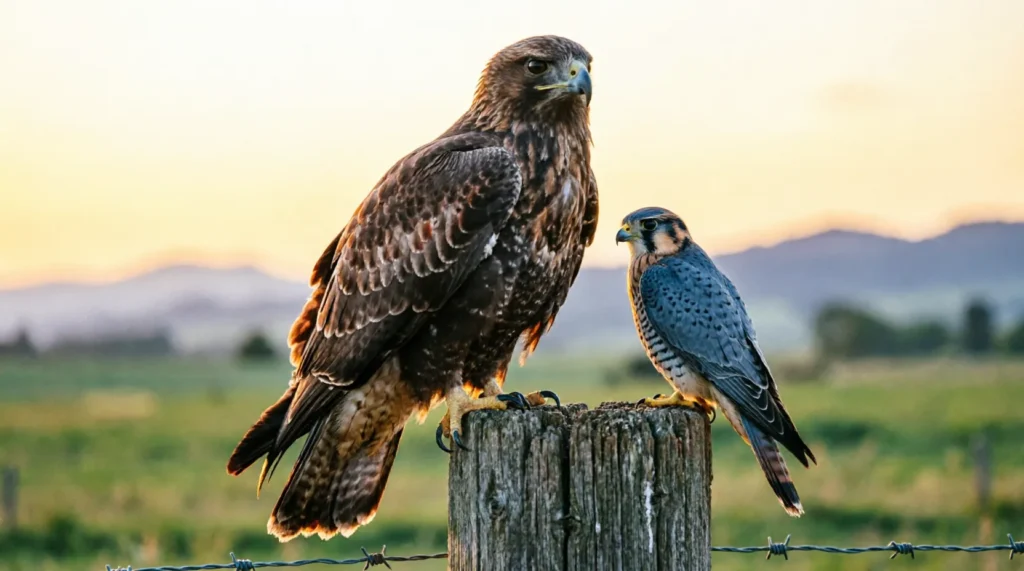
Quick answer: Generally, hawks are bigger than falcons. Most hawk species have larger bodies, broader wings, and heavier builds compared to their falcon counterparts, though there’s significant overlap depending on the specific species you’re comparing.
If you’ve ever spotted a raptor soaring overhead and wondered whether you’re looking at a hawk or a falcon, you’re not alone. These magnificent birds of prey share similar habitats and hunting styles, which makes telling them apart challenging for even experienced birdwatchers. The size difference between hawks and falcons is one of the most reliable ways to distinguish them, but the answer isn’t always straightforward since both groups include species ranging from small to quite large.
| Term | Meaning / When to use | Example sentence |
|---|---|---|
| Hawk | A medium to large bird of prey from the Accipitridae family, typically with broad wings and a stocky build; use when referring to larger raptors like Red-tailed Hawks or Cooper’s Hawks | “The red-tailed hawk circled lazily above the meadow, its broad wings catching the thermal updrafts.” |
| Falcon | A bird of prey from the Falconidae family, usually sleeker and more agile with pointed wings; use when referring to faster, more streamlined raptors like Peregrine Falcons or American Kestrels | “The peregrine falcon dove at incredible speed, reaching over 200 mph as it pursued its prey.” |
When Hawks Are Bigger: Understanding the Size Advantage
Hawks typically dominate the size category when you’re comparing birds of prey. Most hawk species range from about 14 to 26 inches in length with wingspans between 28 and 52 inches, and they tend to have heavier, more robust bodies built for soaring and hunting from perches. The Red-tailed Hawk, one of the most common species across North America, weighs between 2 to 4 pounds and has a wingspan averaging around 48 inches.
I’ve watched countless birdwatchers mistake a large falcon for a small hawk, but the body structure tells the real story. Hawks have broader chests, thicker legs, and wider tails that give them that characteristic bulky appearance. When I’m reviewing wildlife photography submissions, I often point out that a hawk’s silhouette looks more like a cross with its wide wings and broad tail, while falcons appear more like darts with their streamlined bodies and pointed wingtips.
Consider these real-world examples:
- Email to a nature group: “Spotted what I think was a Cooper’s Hawk today—definitely bigger than the falcons we usually see near the feeder.”
- Field journal entry: “Red-tailed Hawk observed: approximately 22 inches long, wingspan appeared around 4 feet, much stockier than the merlin falcon from last week.”
- Social media post: “Finally got a clear photo! This hawk is HUGE compared to the kestrels that visit my yard.”
size comparisons between species groups require looking at typical representatives rather than extremes (Bigger). When we apply this to raptors, the average hawk species does outweigh and outsize the average falcon species.
When Falcons Compete: The Speed Over Size Trade-Off
Falcons sacrifice bulk for speed and agility, which explains why they’re generally smaller than hawks. Most falcon species measure between 10 to 24 inches in length with wingspans ranging from 20 to 48 inches. The Peregrine Falcon, famous for being the fastest animal on Earth, weighs only 1.5 to 3.5 pounds despite having a wingspan of up to 48 inches—notice how that wingspan matches the Red-tailed Hawk, but the falcon achieves it with a much lighter, more aerodynamic frame.
The key distinction I teach my wildlife photography students is this: if the bird looks like it could win a drag race, it’s probably a falcon; if it looks like it could win a wrestling match, it’s likely a hawk. Falcons have evolved for high-speed pursuit, which means every ounce of unnecessary weight has been eliminated through evolution. Their bodies are built like fighter jets—sleek, efficient, and incredibly fast.
Real examples from the field:
- Birding app log: “American Kestrel (falcon): 10 inches, 0.3 lbs—tiny compared to the Red-shouldered Hawk (18 inches, 1.5 lbs) I saw yesterday.”
- Nature center newsletter: “Our resident Peregrine Falcon weighs just 2 pounds but can reach speeds over 240 mph in a dive.”
- Email to ornithologist: “Question: Is this a large falcon or small hawk? Bird measured about 16 inches with very pointed wings.”
The Falcon family includes some surprisingly large species, like the Gyrfalcon, which can reach 24 inches and weigh up to 4.5 pounds—making it larger than some smaller hawk species. However, even the largest falcons maintain that characteristic lean, aerodynamic build that prioritizes speed over raw power.
How to Remember the Difference: Size and Shape Memory Tricks
Here’s the memory trick I’ve used for over 20 years of bird identification: Hawks are Heavy, Falcons are Fast. The alliteration helps, but more importantly, it captures the essential evolutionary trade-off. Hawks evolved to be powerful hunters that can carry relatively large prey back to their nests, which requires substantial muscle mass and bone structure. Falcons evolved to intercept prey in mid-air at blistering speeds, which demands minimal weight and maximum aerodynamic efficiency.
Another trick that works well: think of the word “hawk” as having a broader, chunkier sound—it starts with the guttural “h” and ends with the hard “k,” mimicking the bird’s stocky build. “Falcon” flows more smoothly with its softer sounds, reflecting the bird’s streamlined grace.
When I’m teaching beginners, I tell them to imagine the birds as vehicles: a hawk is like an SUV—powerful, capable of carrying heavy loads, built for endurance. A falcon is like a sports car—lightweight, built for speed, designed to get from point A to point B as quickly as possible.
Common Mistakes and Exceptions: When Size Alone Won’t Help
The biggest mistake I see people make is assuming all hawks are bigger than all falcons. While this is generally true, there are important exceptions. The Gyrfalcon, the largest falcon species, can actually outweigh smaller hawk species like the Sharp-shinned Hawk or the Cooper’s Hawk. A large female Gyrfalcon can weigh 4.5 pounds, while a male Sharp-shinned Hawk might weigh only 8 ounces.
Another common error is confusing juvenile birds with adults. Young hawks and falcons often have different proportions than their parents, and inexperienced birdwatchers frequently misidentify them based on size alone. I once received a photo from an excited birder who was certain they’d discovered a new species—it turned out to be a juvenile Red-tailed Hawk that hadn’t yet developed its full adult size and plumage.
Regional variations also trip people up. In North America, the size difference between hawks and falcons is quite pronounced, but in other parts of the world, the species mix is different. Someone used to European birds might struggle when birdwatching in South America or Asia, where different species with different size relationships exist.
The exception that catches most people: the American Kestrel is the smallest falcon in North America at just 10 inches long, while the Red-tailed Hawk is one of the larger common hawks at 22 inches. That’s more than double the length! But compare a Gyrfalcon to a Sharp-shinned Hawk, and suddenly the falcon is the bigger bird.
Frequently Asked Questions
Can a falcon ever be bigger than a hawk? Yes, the largest falcon species (like the Gyrfalcon) can be bigger than the smallest hawk species (like the Sharp-shinned Hawk), though this is the exception rather than the rule.
What’s the biggest difference between hawks and falcons besides size? Beyond size, hawks have broad, rounded wings and long tails for maneuvering through forests, while falcons have pointed, swept-back wings built for high-speed flight in open areas.
Which is more common to see in suburban areas? In most North American suburbs, you’re more likely to see Red-tailed Hawks and Cooper’s Hawks during the day, though Peregrine Falcons have adapted well to urban environments and nest on tall buildings.
Do hawks and falcons ever compete for the same prey? Yes, they often hunt similar prey like small mammals and birds, but falcons typically catch their prey in mid-air while hawks often hunt from perches or by soaring and diving.

Samantha Jones graduated with a Bachelor’s degree in English Literature from Oxford University and has been involved in language education for over 15 years. Her expertise lies in comparative language analysis, focusing particularly on the differences and similarities in spelling across various English dialects. Samantha’s passion for this niche developed from her love of storytelling and desire to preserve the subtle differences that make English unique around the globe. On SpellRightDaily, she crafts detailed articles that compare common spelling errors and offer practical advice for writers and editors looking to polish their work. Samantha’s content is known for its clarity and depth, helping readers decode complex spelling issues and improve their writing skills. She also enjoys delving into the psychology of language learning, and how cognitive factors influence the retention of correct spelling patterns. Her engaging writing encourages a deeper appreciation of the language’s rich diversity.