

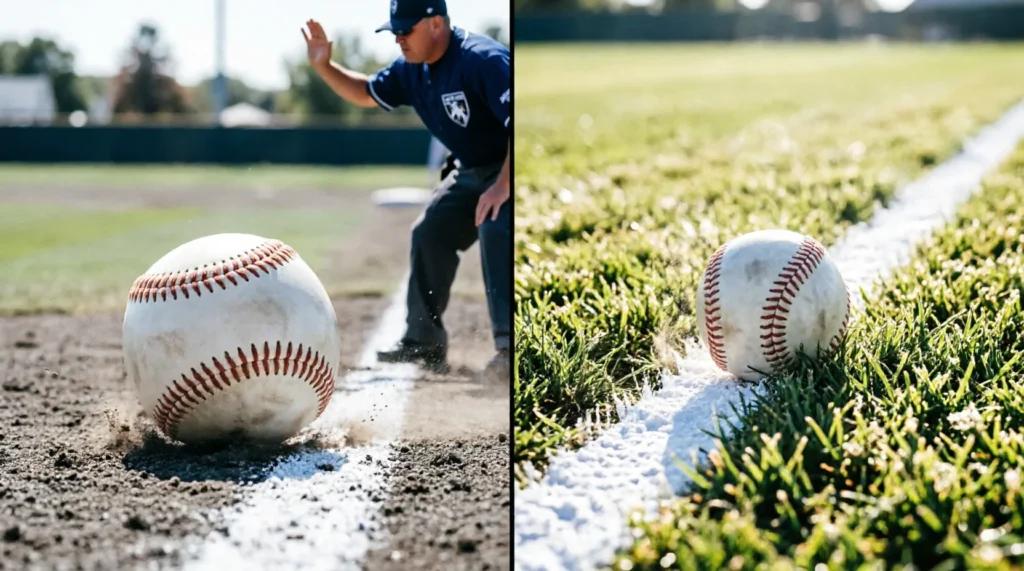
Quick answer: A foul ball is a batted ball that settles or is touched in foul territory, while a fair ball is one that settles or is first touched in fair territory. The distinction depends entirely on where the ball lands or is fielded relative to the foul lines, not just where it initially crosses the plate.
Many baseball and softball fans, players, and even new umpires struggle with the precise boundary between a foul and a fair ball. The confusion often stems from misinterpreting the trajectory of the ball rather than its final resting place or point of contact. Understanding this difference is critical because it determines whether the batter remains at the plate, advances runners, or records an out.
| Term | Meaning / When to use | Example sentence |
|---|---|---|
| Foul ball | A batted ball that settles on foul territory between home and first base, or between home and third base, or that bounds past first or third base on or over foul territory. | The batter swung hard, but the ball sliced into the stands near the third-base dugout, resulting in a foul ball. |
| Fair ball | A batted ball that settles on fair territory between home and first base, or between home and third base, or that bounds past first or third base within fair territory. | The shortstop dove but missed, and the ball rolled deep into the outfield grass, clearly a fair ball that allowed the runner to score. |
When to use foul ball
A foul ball is called when a batted ball meets specific criteria defined by the rules of baseball and softball. According to Wikipedia, a foul ball is generally one that settles on foul territory between home and first base or between home and third base. It also includes any ball that bounds past first or third base on or over foul territory, or that first falls on foul territory beyond first or third base.
The key factor is the position of the ball relative to the foul lines. The foul lines themselves are considered part of fair territory. Therefore, if a ball lands directly on the white chalk line, it is a fair ball. However, if it lands even an inch outside that line in foul territory, it is a foul ball.
Here are common scenarios where a foul ball is correctly called:
- The ball is hit high into the air and caught by a fielder who is standing in foul territory. Even if the fielder reaches into fair territory to make the catch, if their feet are in foul space, it is often ruled a foul ball depending on specific league interpretations, but generally, the position of the ball at the moment of touch matters most.
- A ground ball rolls down the third-base line and stops in the dirt area outside the line before reaching first base.
- A fly ball lands in the stands behind the backstop or along the sides of the field beyond the outfield fence.
In my years editing sports manuscripts, I frequently see writers confuse a “foul tip” with a foul ball. A foul tip is a specific type of foul ball where the batter hits the ball slightly, and it goes directly into the catcher’s glove and is legally caught. This results in an out, unlike a standard foul ball which simply counts as a strike (unless the batter already has two strikes).
Consider this real-world example from a youth league game report:
- Incorrect: “The batter hit a fair ball into the stands behind first base.”
- Correct: “The batter hit a foul ball into the stands behind first base.”
Another common error appears in resume descriptions for coaching positions:
- Incorrect: “Taught players to distinguish between fair and foul balls based on where they crossed the plate.”
- Correct: “Taught players to distinguish between fair and foul balls based on where they settled or were first touched relative to the baseline.”
When to use fair ball
A fair ball is the desired outcome for any batter. It allows play to continue, runners to advance, and the possibility of scoring runs. As noted in general definitions of fairness in sports contexts, a fair ball adheres to the established boundaries of play (Wikipedia). In baseball, a fair ball is one that settles on fair territory between home and first base or between home and third base.
It also includes any ball that bounds past first or third base within fair territory, or that first falls on fair territory beyond first or third base. Crucially, a ball that touches the foul pole is a fair ball. The foul poles are extensions of the foul lines and are considered part of fair territory. If a ball hits the yellow pole above the outfield fence, it is a home run.
Here are typical situations where a fair ball is correctly called:
- A ground ball rolls along the first-base line and stays inside the white chalk as it passes first base.
- A fly ball is caught by an outfielder who is standing in fair territory, even if their momentum carries them into foul territory after the catch.
- A line drive hits the foul pole in right field and bounces back into the field of play.
The distinction is vital for scoring. A fair ball that leaves the field of play in flight is a home run. A fair ball that bounces over the outfield fence is a ground-rule double. Misidentifying these can lead to significant errors in box scores and game summaries.
I often correct articles that describe a ball as “fair” simply because it was hit hard. Hardness does not determine fairness; location does. For instance:
- Incorrect: “He smashed a foul ball over the left-field fence for a home run.”
- Correct: “He smashed a fair ball over the left-field fence for a home run.”
In a text message to a coach discussing a controversial call:
- Incorrect: “That was definitely a foul ball because it curved left.”
- Correct: “That was definitely a fair ball because it landed on the line before curving left.”
How to remember the difference
The most effective mnemonic for distinguishing between foul and fair balls is to focus on the lines. The foul lines are actually fair lines. If the ball touches the line, it is fair. Think of the line as a bridge to safety. If the ball stays on the bridge, it is safe (fair). If it falls off the bridge into the water (foul territory), it is foul.
Another helpful trick is to remember the word FOUL has four letters, just like the word OUT. While a foul ball is not always an out, it is often associated with negative outcomes for the batter (strikes). Conversely, FAIR has four letters, but think of it as FREE to advance. A fair ball gives the offense freedom to move.
For umpires and serious fans, visualize the “V” shape created by the foul lines extending from home plate. Anything inside the V is fair. Anything outside the V is foul. However, remember that this V extends infinitely. A ball that starts inside the V but lands outside the V beyond first or third base is foul. A ball that starts outside the V but lands inside the V beyond first or third base is fair. The critical points are where the ball passes first or third base.
Common mistakes and exceptions
One of the most persistent mistakes is assuming that the position of the fielder determines the status of the ball. It does not. A fielder can stand in foul territory and catch a ball that is in fair territory, resulting in a fair ball out. Conversely, a fielder can stand in fair territory and catch a ball that is in foul territory, resulting in a foul ball. The status of the ball is determined by the position of the ball, not the player.
Another common error involves pop-ups near the foul line. If a ball is hit high in the air and lands in foul territory, it is a foul ball, regardless of how far it traveled. Some fans believe that if a ball is hit far enough, it must be fair. This is incorrect. Distance is irrelevant; location is everything.
There are also specific exceptions in different leagues. In Major League Baseball, a ball that hits the foul pole is a home run. In some amateur leagues, local ground rules may dictate that a ball hitting a specific fence or object is automatically dead or a double. Always check local ground rules, but the fundamental definition of foul vs. fair remains consistent.
A subtle exception involves the batter. If a batter hits a ball and it hits them while they are still in the batter’s box, it is a foul ball. If it hits them after they have left the box, it may be ruled an out or interference, depending on intent and position. This is a nuanced rule that often confuses new players.
In UK English, the term “foul” is also used in other sports like soccer, but the concept of “fair” vs. “foul” in baseball is unique to the diamond’s geometry. Do not confuse baseball’s geographical foul with soccer’s behavioral foul.
Frequently Asked Questions
Is a ball that hits the foul line a foul ball? No, a ball that hits the foul line is a fair ball. The foul lines are considered part of fair territory in baseball and softball.
Can a foul ball result in an out? Yes, a foul ball can result in an out if it is caught in the air by a fielder before touching the ground. This is known as a foul fly out. Additionally, a foul tip caught by the catcher is an immediate out.
What happens if a fair ball hits a bird in the outfield? If a fair ball hits a bird or other foreign object while in play, the ball remains live and in play. The outcome depends on where the ball ends up after the incident. This is a rare but documented occurrence in professional baseball.
Does a foul ball count as a strike? Yes, a foul ball counts as a strike unless the batter already has two strikes. If the batter has two strikes, a foul ball is simply a foul ball and does not result in a strikeout, unless it is a foul tip caught by the catcher.

Samantha Jones graduated with a Bachelor’s degree in English Literature from Oxford University and has been involved in language education for over 15 years. Her expertise lies in comparative language analysis, focusing particularly on the differences and similarities in spelling across various English dialects. Samantha’s passion for this niche developed from her love of storytelling and desire to preserve the subtle differences that make English unique around the globe. On SpellRightDaily, she crafts detailed articles that compare common spelling errors and offer practical advice for writers and editors looking to polish their work. Samantha’s content is known for its clarity and depth, helping readers decode complex spelling issues and improve their writing skills. She also enjoys delving into the psychology of language learning, and how cognitive factors influence the retention of correct spelling patterns. Her engaging writing encourages a deeper appreciation of the language’s rich diversity.