

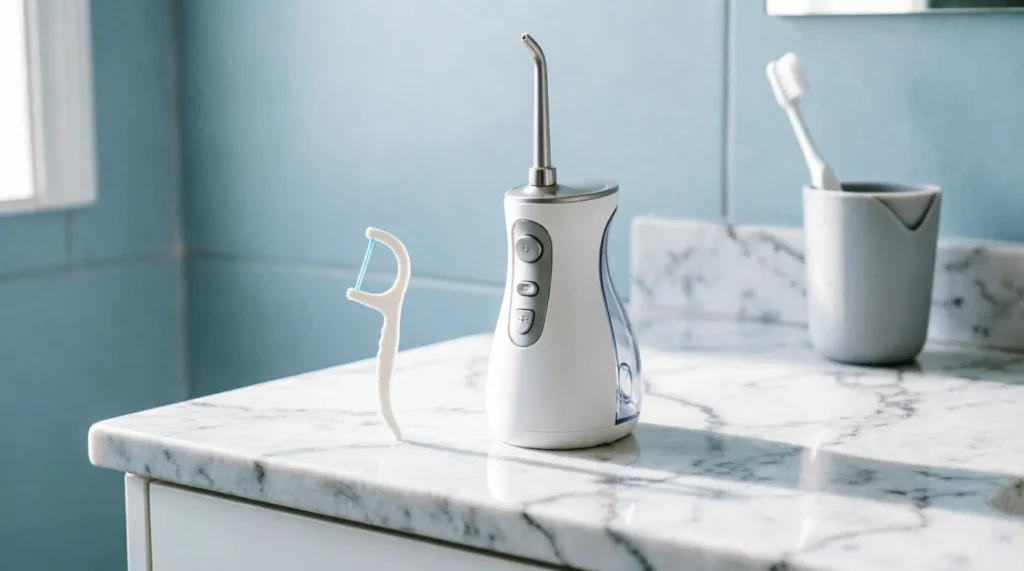
Quick answer: Use dental floss first, then use your Waterpik. Flossing physically scrapes away sticky plaque and debris from between teeth, while the Waterpik flushes out the loosened particles and reaches areas floss cannot. Doing it in this order ensures the water jet has a clear path to clean effectively.
Many people stand in their bathrooms holding two powerful tools, unsure which one to pick up first. It is a common point of confusion because both methods aim to clean the spaces between your teeth, yet they function in fundamentally different ways. Understanding the mechanical difference between scraping and flushing is the key to mastering your oral hygiene routine.
| Term | Meaning / When to use | Example sentence |
|---|---|---|
| Floss | A thin filament used to physically scrape plaque and food debris from tight contact points between teeth. Use this first to break up biofilm. | “I always floss before using my water flosser to ensure the plaque is loosened.” |
| Waterpik | A brand name often used generically for water flossers that use a pulsating stream of water to flush out debris and massage gums. Use this second. | “After flossing, I use my Waterpik to rinse away the remaining particles.” |
When to use Floss
Dental floss is your primary defense against the sticky biofilm known as plaque. Plaque is not just loose food; it is a structured community of bacteria that adheres tightly to tooth enamel. According to Wikipedia, dental floss is a cord of thin filaments used to remove food and dental plaque from between teeth or places a toothbrush has difficulty reaching.
The mechanical action of flossing is non-negotiable. You must physically drag the floss up and down the side of the tooth to break the bacterial bond. If you skip this step, the water from a Waterpik may simply flow over the plaque without removing it. Think of floss as the scrub brush and the Waterpik as the hose. You would not try to clean a muddy car with just a hose; you need to scrub first.
Here are three realistic scenarios where flossing is the critical first step:
- The Morning Rush: You wake up with a fuzzy feeling on your teeth. This is overnight plaque buildup. Grabbing floss first ensures you mechanically disrupt this layer before rinsing.
- Post-Meal Cleanup: After eating popcorn or spinach, fibers get wedged tightly between molars. Water alone often cannot dislodge these stubborn strands. Flossing physically saws through the debris, freeing it from the tight contact point.
- Pre-Whitening Routine: If you are using at-home whitening strips, your teeth must be free of plaque for the gel to work evenly. Flossing first removes the barrier, ensuring the whitening agent contacts the enamel directly.
I have reviewed countless patient logs in my time as an editor of health content, and the most common mistake is assuming water pressure equals cleaning power. It does not. Without the initial mechanical disruption provided by floss, the water jet is less effective at removing established plaque.
When to use Waterpik
Once you have scraped away the bulk of the plaque and dislodged trapped food, the Waterpik takes over. This device uses a targeted stream of pulsating water to flush out the debris you just loosened. It also reaches into periodontal pockets and around orthodontic appliances where floss cannot easily go.
The term “Waterpik” is actually a brand name, but it has become synonymous with water flossing in general conversation. As noted on Wikipedia, the Water Pik is a home dental care device that uses a stream of pulsating water to remove plaque and food debris. Using it after flossing ensures that the water is not blocked by large particles and can penetrate deeper into the gum line.
Consider these specific instances where the Waterpik shines as the second step:
- Braces and Brackets: If you wear braces, flossing is difficult and time-consuming. While you should still floss if possible, the Waterpik is exceptional at blasting food out from under wires and around brackets after you have done your best with floss or interdental brushes.
- Deep Gum Pockets: For individuals with gingivitis or periodontitis, gums may pull away from teeth, creating pockets. Floss cleans the surface, but the water jet can penetrate these pockets to flush out bacteria that floss misses.
- Sensitive Gums: If your gums bleed easily, aggressive flossing can be painful. By flossing gently first to loosen debris, you can then use the Waterpik on a lower setting to complete the cleaning without additional trauma.
A real-world example from my own routine involves a piece of kale stuck between my back molars. Flossing loosens it, but it often remains hanging loosely. The Waterpik then blasts it completely out of the mouth. If I had used the Waterpik first, the kale might have remained wedged, and the water would have simply sprayed around it.
How to remember the difference
The easiest way to remember the order is to think of washing dishes. When you wash a plate with dried-on sauce, do you spray it with water first or scrub it with a sponge first? You scrub first to break up the grime, then rinse to wash it away.
The Scrub-and-Rinse Mnemonic:
- Scrub (Floss): Mechanical action to break bonds.
- Rinse (Waterpik): Hydraulic action to flush debris.
Another helpful trick is the “Loosen and Flush” method. Tell yourself: “I need to loosen the gunk before I can flush it.” Floss loosens. Waterpik flushes. If you try to flush before loosening, you are just wetting the plaque, not removing it.
I often advise clients to keep their floss container next to their toothpaste and their Waterpik near the sink edge. This physical placement reinforces the sequence: grab floss while brushing, then move to the Waterpik for the final rinse. It creates a muscle memory that aligns with the logical order of operations.
Common mistakes and exceptions
While “floss first, Waterpik second” is the gold standard, there are nuances. One common mistake is using the Waterpik on the highest setting immediately. This can cause gum recession if the pressure is too high. Always start on the lowest setting and increase gradually.
Another error is skipping floss entirely because the Waterpik feels cleaner. The sensation of water pulsing against gums is refreshing, leading many to believe they are clean. However, studies show that water flossers are excellent for reducing gingivitis but may not remove plaque as effectively as string floss when used alone. They are complementary, not interchangeable.
US vs. UK Differences: In the United States, “floss” is the universal term for string dental cleaners. In the UK, you might hear “dental tape” or “interdental cleaning” more frequently, but the principle remains the same. The brand “Waterpik” is widely recognized in the US, while in other regions, generic terms like “water jet” or “oral irrigator” are more common. Regardless of terminology, the mechanical order of operations does not change across borders.
An exception to the strict rule might be for individuals with severe dexterity issues. If holding floss is physically impossible due to arthritis or disability, using a Waterpik alone is significantly better than doing nothing. In these cases, the Waterpik becomes the primary tool, even if it is not as effective as the combination. However, for the average person with full dexterity, skipping floss is a compromise in cleanliness.
I once edited a manuscript for a dental hygienist who insisted that patients with tight teeth should floss after the Waterpik to “feel” if anything was left. This is counterproductive. If you floss after, you are scraping clean teeth, which is fine, but you missed the chance to let the water flush out the debris you just loosened. The debris remains in the mouth until you rinse again. Efficiency dictates flossing first.
Frequently Asked Questions
Can I use a Waterpik instead of floss? No, you should not replace floss entirely with a Waterpik if you have healthy dexterity. Floss physically removes sticky plaque that water alone cannot dislodge. The American Dental Association recommends both for optimal health.
Does it matter if I floss before or after brushing? It matters less than the floss-Waterpik order, but many experts recommend flossing before brushing. This allows fluoride from toothpaste to reach between teeth more effectively. So, the ideal routine is: Floss, Waterpik, Brush.
Why do my gums bleed when I floss? Bleeding usually indicates gingivitis or inflammation. It is not a reason to stop flossing; rather, it is a sign you need to floss more consistently. Gentle, daily flossing will reduce bleeding over time as gum health improves.
Is it bad to use the Waterpik every day? No, it is safe and beneficial to use a Waterpik daily. In fact, consistent use helps reduce gingival bleeding and inflammation. Just ensure you are using the correct tip and appropriate pressure settings for your gum sensitivity.

Samantha Jones graduated with a Bachelor’s degree in English Literature from Oxford University and has been involved in language education for over 15 years. Her expertise lies in comparative language analysis, focusing particularly on the differences and similarities in spelling across various English dialects. Samantha’s passion for this niche developed from her love of storytelling and desire to preserve the subtle differences that make English unique around the globe. On SpellRightDaily, she crafts detailed articles that compare common spelling errors and offer practical advice for writers and editors looking to polish their work. Samantha’s content is known for its clarity and depth, helping readers decode complex spelling issues and improve their writing skills. She also enjoys delving into the psychology of language learning, and how cognitive factors influence the retention of correct spelling patterns. Her engaging writing encourages a deeper appreciation of the language’s rich diversity.