

Quick answer: Use ensure in formal writing, professional emails, and technical documentation. Use make sure in casual conversation, informal texts, and spoken English. Both mean “to guarantee,” but ensure carries a tone of authority and precision, while make sure is conversational and direct.
Writers often stumble over the choice between ensure and make sure. It is a classic friction point where formal register clashes with everyday speech. You might draft a serious business proposal and wonder if “make sure” sounds too casual, or you might send a quick text to a colleague and worry that “ensure” sounds stiff. The distinction is not about right versus wrong in a grammatical sense; both are valid English. The difference lies entirely in tone, context, and audience expectation.
| Term | Meaning / When to use | Example sentence |
|---|---|---|
| Ensure | To make certain something happens; best for formal, professional, or technical contexts. | Please ensure all safety protocols are followed before starting the machine. |
| Make sure | To check or verify something; best for informal, conversational, or spoken contexts. | Can you make sure the door is locked when you leave? |
When to use ensure
I have spent two decades editing corporate communications, and I see ensure used incorrectly far less often than I see it avoided out of fear. Many writers think it sounds pretentious. It does not. It sounds precise. Ensure is the preferred verb when you need to convey responsibility, obligation, or a systematic guarantee. It implies that steps have been taken to prevent failure.
Use ensure when the stakes are high or the setting is professional. It is the standard verb in legal contracts, safety manuals, academic papers, and official company policies. It suggests a level of diligence that make sure sometimes lacks. ensure is transitive, meaning it must take a direct object or a clause following it. You cannot just “ensure.” You must ensure something.
Consider these examples where ensure is the superior choice:
- In a project management email: “We must ensure that the client receives the final deliverables by Friday noon.” (This sounds authoritative and committed.)
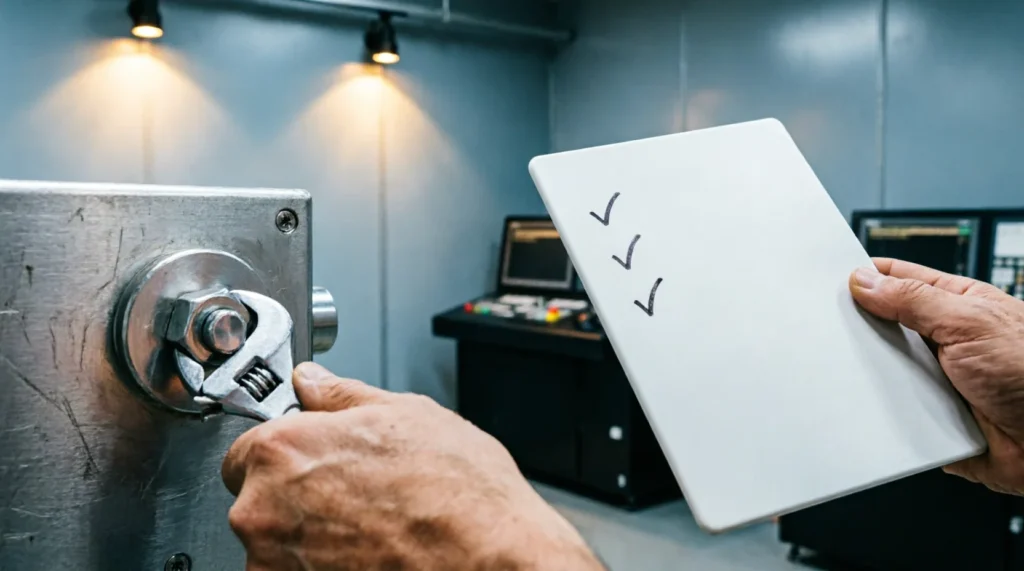
- In a technical manual: “The operator must ensure the pressure valve is closed before maintenance.” (This sounds like a mandatory safety protocol.)
- In a resume bullet point: “Implemented new QA tests to ensure 99.9% uptime for critical services.” (This sounds professional and results-oriented.)
Notice how ensure pairs well with abstract nouns like compliance, accuracy, safety, and success. It elevates the sentence from a simple request to a statement of professional duty. If you are writing for an audience that values precision—engineers, lawyers, executives, or academics—ensure is your default verb. It signals that you have considered the outcome and are taking active measures to secure it.
When to use make sure
Make sure is the workhorse of daily communication. It is phrasal, friendly, and immediate. While ensure looks at the system, make sure often looks at the specific action. It is the verb you use when you are talking to friends, family, or close colleagues in a relaxed environment. It is also the preferred choice in spoken English because it flows more naturally in conversation.
You should use make sure when you want to sound approachable rather than authoritative. It is perfect for reminders, casual checks, and personal interactions. Using ensure in a text message to your spouse (“Please ensure you buy milk”) can sound cold or oddly formal. Make sure keeps the tone light and human. For more, see Ensure.
Here are realistic scenarios where make sure is the better fit:
- In a text message to a friend: “Hey, can you make sure you bring the charger tonight?” (This sounds natural and friendly.)
- In a casual team chat: “I’ll make sure to grab coffee on my way in.” (This sounds like a normal human interaction, not a corporate mandate.)
- In a verbal reminder: “Did you make sure to turn off the stove?” (This is how people actually speak.)
The phrase make sure is also useful when you are asking someone to perform a quick verification. It implies a momentary check rather than a systemic guarantee. For instance, “Make sure you have your keys” is a quick prompt. “Ensure you possess your keys” is bizarrely formal for the same situation. Do not be afraid to use make sure in internal emails with teammates you know well. It builds rapport and reduces the perceived distance between sender and receiver.
How to remember the difference
The easiest way to distinguish these two is to look at the structure of the words themselves. Ensure starts with “en-,” a prefix that often means “to cause to be” or “to put into.” Think of enable, enact, or enforce. These are active, formal verbs. Make sure contains the word “sure,” which is short, simple, and conversational.
Here is my favorite mnemonic trick: Ensure is for Executives and Engineers. Make sure is for Mates and Messages.
If you are writing to someone who signs their emails with a full title and department, use ensure. If you are writing to someone who uses emojis or first names only, use make sure. Another helpful tip is to listen to the rhythm of your sentence. Ensure is one syllable (if you pronounce it quickly) or two, and it sits heavily in the sentence. Make sure is two distinct beats. If the sentence feels clunky with ensure, try make sure. If it feels too loose with make sure, tighten it with ensure.
Also, consider the noun form. We talk about “assurance” or “insurance,” which are related to ensure. We do not talk about “make-surance.” If you can replace the verb with “guarantee,” ensure is usually the better written choice. If you can replace it with “check,” make sure is likely the better spoken choice.
Common mistakes and exceptions
One of the most frequent errors I correct is the confusion between ensure, insure, and assure. While this article focuses on ensure vs. make sure, it is vital to note that ensure is not interchangeable with insure. Insure relates specifically to financial compensation for loss or damage, such as car insurance. Ensure relates to making certain an event happens. Do not write “Please insure the package arrives on time.” Write “Please ensure the package arrives on time.”
Another common mistake is using ensure without an object. You cannot say, “I will ensure.” You must say, “I will ensure that it happens” or “I will ensure its arrival.” Make sure has the same requirement, but it is more forgiving in casual speech where the object might be implied by context. In formal writing, never drop the object after ensure.
There is also a regional nuance to consider. In British English, ensure is standard for “make certain.” However, some older style guides or dialects might use insure in place of ensure, though this is increasingly rare and generally considered incorrect in modern standard English. Stick to ensure for clarity regardless of your location. For more, see Make.
A subtle exception exists in creative writing. Dialogue should reflect character. A professor might say, “Ensure you cite your sources,” while a student might reply, “I’ll make sure I do.” Mixing these up breaks character voice. Always match the verb to the speaker’s persona. If a character is formal, they ensure. If they are casual, they make sure.
Finally, avoid the redundant phrase “ensure and make sure.” Choose one. “Please ensure and make sure the lights are off” is wordy and weak. Pick the verb that fits the context and delete the other. Precision is the hallmark of good writing.
Frequently Asked Questions
Is “ensure” more formal than “make sure”? Yes, ensure is significantly more formal and is preferred in professional, academic, and technical writing, while make sure is suitable for casual conversation and informal communication.
Can I use “make sure” in a business email? You can use make sure in internal emails to close colleagues or in casual business contexts, but switch to ensure for external clients, formal proposals, or official policy documents to maintain a professional tone.
What is the difference between “ensure” and “insure”? Ensure means to make certain something happens, while insure refers to protecting against financial loss through an insurance policy; they are not interchangeable in standard English.
Is it grammatically correct to start a sentence with “Ensure”? Yes, it is grammatically correct to start a sentence with Ensure when issuing a directive or instruction, such as “Ensure all doors are locked,” which is common in manuals and safety guidelines.

Samantha Jones graduated with a Bachelor’s degree in English Literature from Oxford University and has been involved in language education for over 15 years. Her expertise lies in comparative language analysis, focusing particularly on the differences and similarities in spelling across various English dialects. Samantha’s passion for this niche developed from her love of storytelling and desire to preserve the subtle differences that make English unique around the globe. On SpellRightDaily, she crafts detailed articles that compare common spelling errors and offer practical advice for writers and editors looking to polish their work. Samantha’s content is known for its clarity and depth, helping readers decode complex spelling issues and improve their writing skills. She also enjoys delving into the psychology of language learning, and how cognitive factors influence the retention of correct spelling patterns. Her engaging writing encourages a deeper appreciation of the language’s rich diversity.