

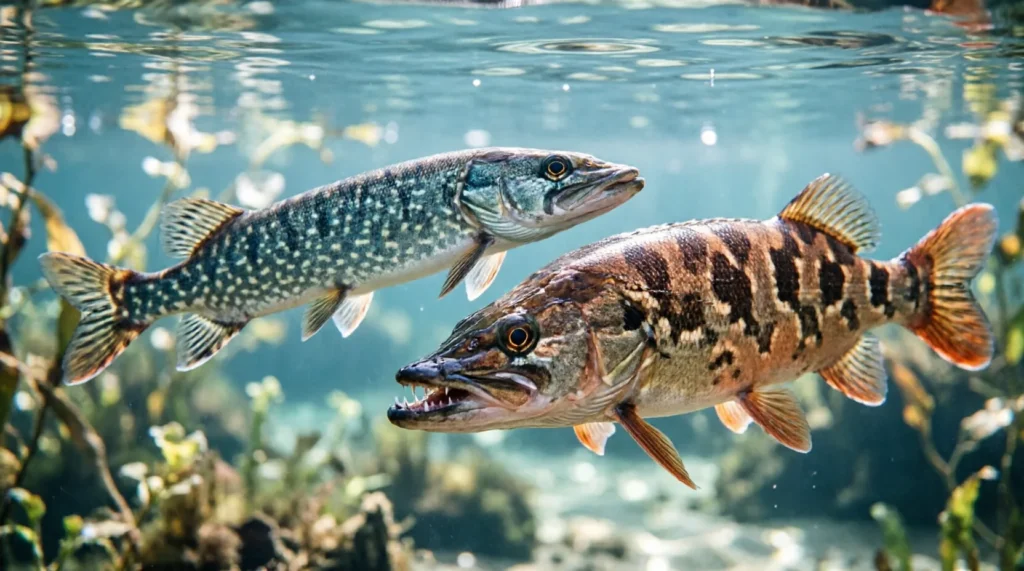
Quick answer: Pike and muskie are different species; pike have light markings on a dark body and rounded tail fins, while muskies have dark markings on a light body and pointed tail fins.
Anglers and nature enthusiasts constantly mix up northern pike and muskellunge because they share the same family, habitat, and torpedo-shaped silhouette. This confusion is understandable, as the visual difference between these two apex predators can be subtle to the untrained eye, especially when viewing a fish quickly in murky water or from a distance. However, correctly identifying them is critical for following fishing regulations, as muskies often have strict catch-and-release protocols that do not apply to pike.
| Term | Meaning / When to use | Example sentence |
|---|---|---|
| Northern Pike | Use for the smaller, more abundant esocid with light-colored spots or bars on a dark olive-to-green background and a fully rounded caudal fin. | “We caught three northern pike in the weedy bay before noon.” |
| Muskellunge (Muskie) | Use for the larger, rarer esocid with dark vertical bars or spots on a silver-to-light-green background and a distinctly forked, pointed caudal fin. | “The guide released the 48-inch muskie after a quick photo.” |
When to use northern pike
Use “northern pike” (or simply “pike”) when you are describing the widespread, aggressive freshwater predator that typically ranges from 20 to 30 inches in most North American waters. This term applies to Esox lucius, a fish defined biologically by its light-on-dark coloration pattern and lack of sensory pores on the lower jaw. In my years editing outdoor magazines, I frequently correct writers who call any large, toothy freshwater fish a “muskie,” but if the fish has a duckbill snout and cream-colored bean-shaped spots against a green backdrop, it is unequivocally a pike.
- “The tournament weigh-in included five northern pike, all weighing between four and seven pounds.”
- “Northern pike thrive in shallow, vegetated bays where they ambush perch and suckers.”
- “If the tail fin is completely rounded like a fan, you are holding a northern pike, not a muskie.”
When to use muskellunge
Use “muskellunge,” “muskie,” or “muskies” only when referring to Esox masquinongy, the largest member of the pike family that is native to specific drainages in the Great Lakes region, Ohio River valley, and parts of Canada. This term denotes a fish that generally exceeds 35 inches at maturity, possesses dark-on-light pigmentation, and features six or more sensory pores on each side of the lower jaw. I once reviewed a state tourism brochure that labeled every trophy-sized pike as a “muskie” to make the destination sound more exciting; this is not only taxonomically wrong but potentially illegal, as anglers relying on that guide could face fines for keeping a protected species.
- “Muskellunge require a special tag in Wisconsin, unlike northern pike which fall under general gamefish limits.”
- “The dark, irregular vertical bars on a silver body confirm this specimen is a muskellunge.”
- “True muskies have pointed tail lobes that distinguish them from the rounded tails of northern pike.”
How to remember the difference
The most reliable memory trick I teach new editors and anglers alike is the “Light/Dark Reversal Rule”: pike are light marks on dark, muskies are dark marks on light. Think of the word “pike” as containing the letter “i,” which looks like a single light spot on a dark page, while “muskie” contains the letter “u,” which resembles a dark cup holding light liquid. This mnemonic works because pigmentation is genetically fixed and does not change with age, water clarity, or season, unlike size or behavior which can overlap significantly between the two species.
Another editor-level insight involves counting submandibular pores, a technique far more definitive than color alone since pigment can fade in stressed fish. Northern pike always have five or fewer sensory pores on each side of the lower jaw, while muskellunge consistently have six or more. If you cannot see the pores clearly due to slime or lighting, default to the tail shape test: a fully rounded caudal fin margin indicates pike, while distinct points at both the upper and lower lobes indicate muskie. This morphological distinction remains accurate even for hybrid tiger muskies, which inherit the pointed tail from their muskie parent regardless of their variable bar patterns.
For field identification without handling, focus on the cheek and opercle scale coverage rather than trying to count pores from a distance. Northern pike have scales on both the cheek and gill cover, creating a uniform textured appearance across the entire head region behind the eye. Muskellunge have scaled cheeks but bare, smooth gill covers, giving the rear portion of the head a noticeably shinier, scaleless appearance that catches light differently in photographs. This visual cue is particularly useful when reviewing submitted angler photos for publication, as it allows verification without requiring the fish to be removed from the water or physically examined.
Common mistakes and exceptions
The most pervasive error I encounter is assuming size determines species; many anglers believe any pike-family fish over 30 inches must be a muskie, but northern pike regularly exceed 40 inches in productive Canadian and Alaskan waters. Conversely, juvenile muskies under 20 inches are routinely misidentified as pike because their barring has not yet developed into the classic adult pattern, leading to accidental harvest violations in states with minimum length restrictions specifically designed to protect young muskies. Always verify using multiple characteristics—color, tail shape, and pore count—rather than relying on length estimates that are notoriously inaccurate when made from boat-side observations.
Hybrid tiger muskies (Esox masquinongy × Esox lucius) represent another significant exception that confuses even experienced outdoors writers. These sterile hybrids display intermediate traits: they may have the dark-on-light bars of a muskie but arranged in broken, diagonal patterns rather than clean vertical bands, and they always possess the pointed tail fin inherited from the muskie parent. Tiger muskies are stocked intentionally in many reservoirs outside the native muskie range, so encountering one in Colorado or Utah does not indicate a natural muskie population; however, they are still regulated as muskellunge in most jurisdictions, meaning the same protective measures apply despite their hybrid status.
Regional terminology also creates unnecessary confusion in national publications. In some parts of Ontario and Minnesota, locals use “pickerel” colloquially to refer to small pike, but true pickerel (Esox americanus and Esox niger) are entirely separate, much smaller species with distinct chain-like markings and no conservation concerns comparable to muskies. Using “pickerel” as a synonym for juvenile pike in formal writing perpetuates misinformation and undermines reader trust; reserve that term exclusively for the actual pickerel species and use “young pike” or “juvenile northern pike” when describing immature Esox lucius.
Geographic range provides an additional verification layer that many field guides overlook. Native muskellunge populations exist only in specific drainages connected to the Great Lakes, St. Lawrence River, Ohio River, and Mississippi River headwaters; finding a confirmed muskie outside these areas almost certainly indicates either a stocked tiger muskie or a misidentification. Northern pike, by contrast, have a circumpolar distribution extending across Alaska, Canada, the northern United States, Europe, and Asia, making them the statistically probable identification in any location where the two species’ ranges do not naturally overlap. When editing content about pike-family fish in western U.S. states or European countries, flag any reference to “native muskies” as factually incorrect unless the article specifically discusses introduced stocking programs.
Frequently Asked Questions
Can pike and muskie interbreed in the wild? Yes, natural hybridization occurs where native ranges overlap, producing fertile backcrosses that complicate genetic studies, though most hybrids encountered by anglers are hatchery-produced tiger muskies. These hybrids typically exhibit the pointed tail of the muskie parent combined with irregular, broken bar patterns that differ from either pure species.
Is it legal to keep a muskie if I thought it was a pike? No, regulatory agencies do not accept misidentification as a defense for harvesting protected muskellunge, and penalties can include substantial fines and license suspension. Anglers are expected to positively identify species before retention, and when in doubt, the safest and most ethical choice is always immediate release.
Why do some sources spell it “musky” instead of “muskie”? Both spellings are accepted in informal contexts, but “muskellunge” is the scientifically correct common name derived from Ojibwe origins, and “muskie” is the preferred standardized spelling in fisheries management documents and serious angling literature. I recommend using “muskellunge” on first reference and “muskie” thereafter to maintain editorial consistency while respecting the term’s etymological roots.
Do pike and muskie taste the same? While both are edible white-fleshed fish, muskies are rarely harvested due to conservation status and potential bioaccumulation of mercury in large specimens, whereas pike are widely regarded as excellent table fare when properly prepared to remove Y-bones. Any culinary comparison is largely academic for responsible anglers, as releasing muskies ensures future generations can experience catching them rather than eating them.

Anthony Perez, a PhD in Applied Linguistics from the University of Toronto, has dedicated over 12 years to studying the cognitive aspects of language acquisition, with a special focus on English spelling conventions. His journey into the world of spelling and word comparisons was sparked by his research on how non-native speakers adapt to English orthography. At SpellRightDaily, Anthony shares his insights through content that explores the science behind spelling acquisition and offers strategies for overcoming common traps in English spelling. His articles are particularly aimed at learners who are new to English, although his engaging explanations also attract native speakers interested in refining their spelling skills. Anthony’s research-driven approach provides an evidence-based perspective that enriches the site’s resources, offering readers not just the ‘how’ but the ‘why’ behind effective spelling strategies. His work at SpellRightDaily combines academic rigor with practical application, making complex concepts accessible to a broad audience.