

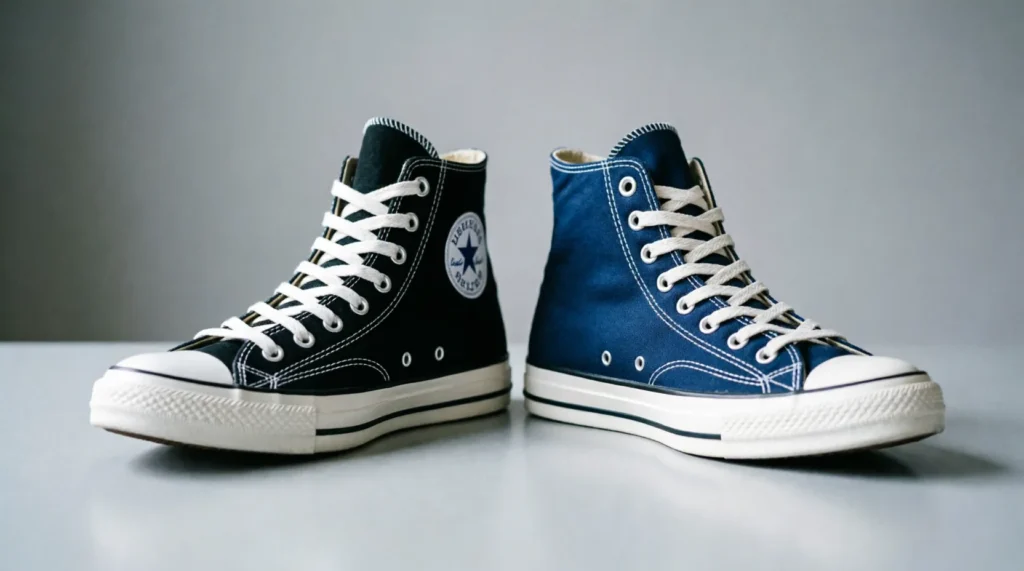
Quick answer: Both are correct brand names for distinct sneaker lines. “Converse” refers to the iconic American footwear company founded in 1908, best known for the Chuck Taylor All Star. “PF Flyers” refers to a heritage brand revived in 2014, originally launched by B.F. Goodrich in 1937 with a focus on anatomical arch support. They are not interchangeable terms; they represent two different companies with separate histories, designs, and cultural footprints.
If you have spent any time browsing vintage shops or scrolling through streetwear forums, you have likely seen these two classic silhouettes side by side. They share a similar low-top canvas aesthetic, a rubber toe cap, and a deep roots in American mid-century culture. This visual similarity leads many shoppers to confuse them or assume one is a generic version of the other. However, the rivalry between Converse and PF Flyers is not just about looks; it is a clash of corporate histories, technological claims, and subcultural allegiances.
Understanding the difference matters if you care about authenticity, comfort technology, or simply knowing what you are buying. While Converse became a blank canvas for punk, rock, and hip-hop, PF Flyers carved a niche as the “anatomically correct” alternative, often associated with a slightly more preppy or retro-athletic vibe. Let’s break down exactly what sets them apart so you can choose the right pair for your rotation.
| Term | Meaning / When to use | Example sentence |
|---|---|---|
| Converse | Use when referring to the brand founded in 1908, specifically the Chuck Taylor All Star or Jack Purcell models. It is the dominant cultural icon in canvas sneakers. | “I wore my black high-top Converse to the concert because they are durable and stylish.” |
| PF Flyers | Use when referring to the brand originally by B.F. Goodrich, known for its “Circular Anatomic Arch Support” and recent revival. | “The PF Flyers felt more supportive during my walk because of the built-in arch cushioning.” |
When to use Converse
You should use the term “Converse” when discussing the global footwear giant that has become synonymous with canvas sneakers. Founded in Malden, Massachusetts, Converse Rubber Shoe Company began by making winterized rubber-soled shoes before launching the All Star basketball shoe in 1917 Converse. The brand’s identity is tightly wound with basketball history, thanks to Charles “Chuck” Taylor, a player who promoted the shoe and eventually had his name added to the patch on the ankle.
Use this term when you are referring to:
- The Chuck Taylor All Star (high top or low top).
- The Jack Purcell (known for the “smile” on the toe cap).
- The modern One Star or Pro Leather models.
- The brand’s massive influence on music scenes, from grunge to pop-punk.
Converse is the default choice for those seeking a cultural staple. It is less about orthopedic innovation and more about attitude. The flat sole and minimal cushioning are features, not bugs, for skaters and musicians who prefer board feel or ground connection.
Consider these real-world scenarios where Converse is the correct reference:
- In a style blog: “The raw denim jeans look best when cuffed above a pair of white leather Converse.”
- In a music review: “The guitarist stomped on his distortion pedal, his worn-out Converse barely holding together after three years of touring.”
- In a retail description: “This limited-edition collaboration features a deconstructed upper typical of modern Converse design experiments.”
When to use PF Flyers
You should use “PF Flyers” when referring to the specific brand that emphasizes anatomical support and heritage athletics. The “PF” stands for “Popular Fitness,” and the brand was originally introduced by the B.F. Goodrich tire company in 1937 Flyers. Unlike Converse, which focused on basketball performance and later cultural adoption, PF Flyers marketed itself on its “Circular Anatomic Arch Support,” a padded insert designed to provide better foot health.
Use this term when you are referring to:
- The classic General or Highlander models.
- The distinctive red, white, and blue branding often found on the heel or tongue.
- The brand’s revival under new ownership starting in 2014, which focuses on premium materials and retro accuracy.
- A preference for slightly more cushioning and arch support than a standard flat canvas shoe provides.
PF Flyers appeal to those who want the vintage look but find traditional Converse too flat or uncomfortable for all-day wear. They occupy a unique space between fashion and functional retro sportswear.
Here are examples of how to correctly use PF Flyers in context:
- In a comfort review: “I switched to PF Flyers for my summer walks because the arch support prevents the foot fatigue I get from flat-soled sneakers.”
- In a vintage collection discussion: “My grandfather kept his original 1950s PF Flyers in the box, showcasing the old B.F. Goodrich branding on the sole.”
- In a fashion comparison: “While the silhouette is similar to a Chuck Taylor, the PF Flyers offer a roomier toe box and a more structured heel counter.”
How to remember the difference
It is easy to mix these two up because they both feature canvas uppers, rubber toe caps, and a similar era of origin. However, there is a simple way to keep them straight in your mind. Think of the “C” in Converse as standing for “Culture.” Converse is the shoe of cultural movements, from basketball courts to punk clubs. It is the blank slate that millions of people have customized with markers, patches, and paint.
Think of the “P” in PF Flyers as standing for “Support.” The brand’s original selling point was its anatomical arch support. If you are looking for a shoe that claims to be better for your feet’s structure, think of PF Flyers. Another helpful mnemonic is to recall that B.F. Goodrich made tires and PF Flyers. Tires need support and structure, just like the arch support in PF Flyers. Converse, on the other hand, was an independent shoe company that became part of Nike, linking it to modern athletic marketing and global lifestyle trends.
When you see a sneaker with a prominent star-and-chevron logo or the name “Chuck Taylor,” it is Converse. When you see a sneaker with a circular arch support claim and often a more colorful or patriotic colorway, it is likely PF Flyers.
Common mistakes and exceptions
One common mistake is assuming that PF Flyers are just a knockoff of Converse. This is historically inaccurate. PF Flyers launched in 1937, two decades after the Converse All Star, but they developed independently with a different technological focus. They were not trying to be Converse; they were trying to be a more supportive athletic shoe. Calling them a “fake Converse” ignores their distinct heritage and the fact that they were a major competitor in the mid-20th century American market.
Another error is confusing the modern ownership structures. Converse was acquired by Nike in 2003, which revitalized the brand with massive marketing budgets and global distribution. PF Flyers, however, faded into obscurity before being revived by a separate entity in the 2010s. They are not owned by Nike. This means quality control, material sourcing, and design philosophy differ significantly between the two today.
There is also a regional exception to consider. In some international markets, Converse is far more ubiquitous, while PF Flyers remains a niche import or a specialty vintage find. Shoppers in Europe or Asia might encounter PF Flyers primarily through online retro retailers, whereas Converse is available in nearly every mall. This availability bias can lead to the assumption that Converse is the “original” and everything else is a copy, which is a simplification of a complex footwear history.
Additionally, do not confuse PF Flyers with other B.F. Goodrich footwear. The tire company produced various rubber goods, but PF Flyers was their specific sneaker line. Similarly, do not confuse Converse with other Nike-owned brands like Jack Purcell, which Converse also owns. While Jack Purcells are sold under the Converse umbrella, they have a distinct design history originating from badminton player Jack Purcell.
Frequently Asked Questions
Are PF Flyers more comfortable than Converse? Many users report that PF Flyers are more comfortable for all-day wear due to their Circular Anatomic Arch Support, which provides more cushioning than the flat sole of a standard Converse Chuck Taylor.
Did B.F. Goodrich really make sneakers? Yes, the B.F. Goodrich tire company launched PF Flyers in 1937 as part of their rubber products division, leveraging their expertise in durable rubber for soles and structural support.
Can I use Converse and PF Flyers interchangeably in writing? No, they are distinct brand names. Using them interchangeably is factually incorrect and may confuse readers who are familiar with the specific heritage and design differences of each brand.
Why did PF Flyers disappear for so long? PF Flyers lost market share to competitors like Converse and Nike in the late 20th century and ceased production for many years before being revived by new owners in 2014 who capitalized on the retro sneaker trend.

Kevin Sanchez holds a Master’s degree in English Linguistics from the University of California, where he cultivated a deep appreciation for the intricacies of language. With over 10 years of experience in the field, Kevin specializes in the nuances of English spelling, particularly the evolution of spelling conventions over time. His fascination with how English words have transformed through cultural and technological influences led him to become a prominent voice at SpellRightDaily. Kevin produces content focused on historical spelling variations and their contemporary implications, offering readers insightful comparisons of British and American English. Beyond this, Kevin has a keen interest in educating readers about the rules that govern standard spelling and the exceptions that often lead to confusion. His articles frequently feature tips for mastering complex spelling patterns and understanding the etymology of perplexing words. Kevin’s dedication to clarity and accessibility makes his contributions invaluable to both casual readers and English language professionals.