

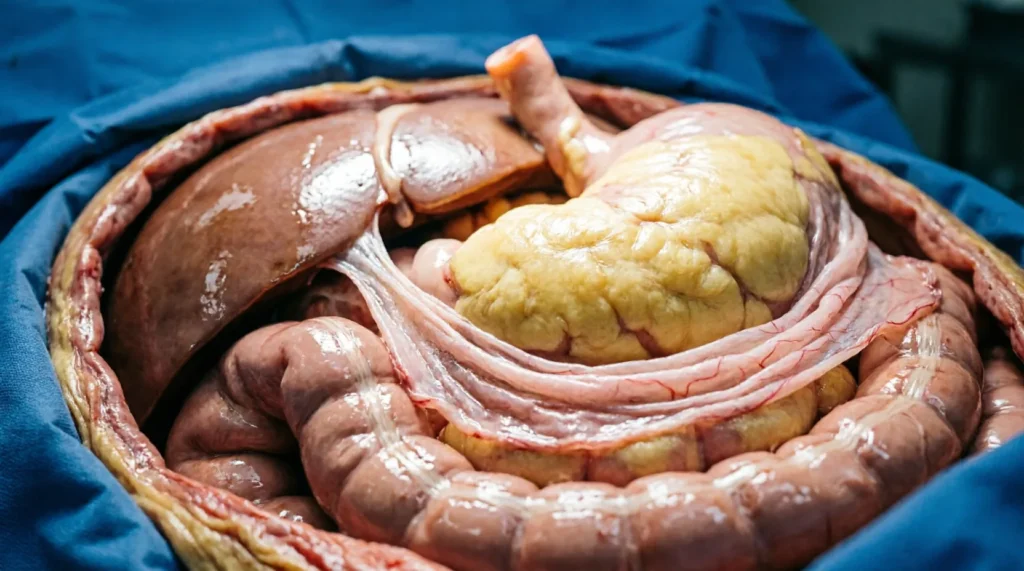
Quick answer: The lesser omentum connects the liver to the stomach and duodenum, while the greater omentum is the large, apron-like fold that drapes over the intestines. Use “lesser” when discussing the hepatogastric ligament and porta hepatis, and “greater” when referring to the gastrocolic ligament, immune defense, or omental patching.
I see this anatomical mix-up constantly in surgical case reports, medical student notes, and clinical coding queries. Because both structures are peritoneal folds attached to the stomach, writers and coders frequently swap “lesser vs greater omentum” when describing abdominal surgeries or inflammatory responses. However, using the wrong term in a clinical document can completely misrepresent the surgical approach, the anatomical site of a complication, or the correct billing code for an omentectomy.
| Term | Meaning / When to use | Example sentence |
|---|---|---|
| Lesser omentum | Use when referring to the double-layered peritoneum connecting the liver to the lesser curvature of the stomach and the duodenum. | The surgeon carefully dissected the lesser omentum to expose the common hepatic artery. |
| Greater omentum | Use when describing the large, fatty, apron-like fold of peritoneum hanging from the greater curvature of the stomach over the intestines. | During the laparotomy, the greater omentum was found adhered to the inflamed appendix. |
When to use lesser omentum
Use this term when the anatomical context involves the liver, the porta hepatis, or the lesser curvature of the stomach. It is a relatively thin, membranous structure containing vital neurovascular bundles that supply the liver and stomach.
The lesser omentum is not just a single, uniform sheet of tissue. It is anatomically divided into two distinct ligaments that medical writers and students frequently confuse in their documentation.
- Hepatogastric ligament: This is the broader, thinner, and more membranous portion connecting the liver directly to the lesser curvature of the stomach.
- Hepatoduodenal ligament: This is the thickened, free right edge of the lesser omentum. It is critically important because it contains the portal triad (the portal vein, hepatic artery proper, and common bile duct).
When editing surgical notes or transcribing lectures, look for references to the “Pringle maneuver.” If a surgeon clamps the hepatoduodenal ligament to control severe bleeding from the liver, they are directly manipulating the lesser omentum.
Here are three realistic examples of how this term should appear in clinical documentation:
- Clinical note: “Bleeding was successfully controlled after ligating the left gastric artery within the lesser omentum.”
- Surgical text: “A suspicious tumor nodule was noted invading the lesser omentum near the hepatoduodenal ligament, requiring careful dissection.”
- Radiology report: “CT imaging reveals a fluid-filled cystic mass located within the lesser sac, positioned immediately posterior to the lesser omentum.”
When to use greater omentum
Use this term when discussing the large, fatty apron that covers the transverse colon and small intestines. It is famous for its role in immunity and is often colloquially called the “policeman of the abdomen” by surgeons.
According to Omentum, this large peritoneal fold is highly vascularized and serves as a primary immune defense mechanism in the abdominal cavity, often migrating to wall off infections.
Structurally, it is a massive, four-layered fold of peritoneum. It descends from the greater curvature of the stomach, folds back up on itself, and attaches to the transverse colon, forming what is known as the gastrocolic ligament.
Surgeons frequently harvest this structure for reconstructive flaps because of its rich, reliable blood supply from the right and left gastroepiploic vessels. It is commonly used to reinforce anastomoses, fill dead space after tumor resection, or cover infected sternal wounds.
Here are three realistic examples of how this term should appear in clinical documentation:
- Operative report: “An omental patch (Graham patch) was created using a well-vascularized segment of the greater omentum to seal the perforated duodenal ulcer.”
- Pathology report: “Metastatic ovarian carcinoma was found studding the greater omentum, necessitating a total infracolic omentectomy for accurate staging.”
- Student essay: “The greater omentum physically migrates to areas of severe inflammation to wrap around the appendix and prevent generalized peritonitis.”
How to remember the difference
The easiest way to never mix these up is to rely on the “Curvature Rule.” The stomach has a lesser curvature (the shorter, medial border) and a greater curvature (the longer, lateral border).
The lesser omentum attaches exclusively to the lesser curvature. The greater omentum attaches exclusively to the greater curvature. If you know your stomach borders, you automatically know your omenta.
You can also use the “Size and Apron” visualization. The greater omentum is massive. It is a giant, fatty apron that drapes down over the guts like a heavy blanket. The lesser omentum is a small, tight, relatively thin membrane connecting two adjacent organs in the upper right quadrant.
For medical students and advanced anatomical writers, the embryological tie is the most reliable memory trick. The lesser omentum derives from the ventral mesogastrium because it connects to the liver, which develops in the ventral mesentery. The greater omentum derives from the dorsal mesogastrium, which elongates dramatically to form the apron and the omental bursa.
In anatomical nomenclature, modifiers like this are used to distinguish size or extent relative to a counterpart. According to Greater, this naming convention helps anatomists differentiate between paired structures like the greater and lesser curvatures of the stomach, which directly dictate which peritoneal fold attaches where.
Common mistakes and exceptions
As a veteran medical copy editor, I have corrected this exact mistake in real manuscripts, clinical notes, and professional correspondence for years. Writers often assume that because the greater omentum is so large, it is the only one worth mentioning, or they confuse the omentum with the mesentery entirely.
Here are three concrete examples of how “lesser vs greater omentum” gets mixed up in the wild, and how to fix them based on real editorial experience.
The Panicked Text Message Error: A surgical resident texts the attending: “Patient has RLQ pain, CT shows fat stranding in the lesser omentum.” Fix: “Greater omentum. The lesser omentum is tucked high in the upper abdomen near the liver; fat stranding in the right lower quadrant is the greater omentum migrating to wrap an inflamed appendix.”
The Coder’s Email Error: An email from a medical coder to the billing department: “Denying claim for omentectomy, the op note says they only took the lesser omentum to patch a gastric ulcer.” Fix: “The surgeon performed a Graham patch using the greater omentum. The lesser omentum houses the portal triad and is never harvested for ulcer patching.”
The Medical Writer’s Resume Error: A resume line from a freelance medical writer: “Specialized in editing GI manuscripts, including correcting anatomical nomenclature regarding the lesser omentum’s role in peritoneal dialysis complications.” Fix: “The greater omentum is the structure that frequently wraps around and occludes peritoneal dialysis catheters, not the lesser omentum.”
Another common edge case involves the hepatoduodenal ligament. Writers sometimes mistakenly refer to the hepatoduodenal ligament as a separate entity entirely from the lesser omentum. In reality, it is technically just the thickened, right free edge of the lesser omentum itself.
Finally, do not confuse the omentum with the mesentery. The mesentery attaches the small and large intestines to the posterior abdominal wall. The omenta specifically and exclusively attach to the stomach.
Frequently Asked Questions
Can a surgeon remove the lesser omentum? While surgeons can biopsy or clear lymph nodes from the lesser omentum during gastric or hepatic cancer staging, they rarely remove it entirely. Doing so would risk catastrophic, life-threatening damage to the portal triad and the left gastric vessels.
Why is the greater omentum called the “policeman of the abdomen”? This nickname comes from its unique, almost mobile ability to physically migrate across the abdominal cavity in response to chemotactic signals. It wraps around inflamed or ruptured organs to contain the infection and prevent fatal sepsis.
Is the omentum the same as visceral belly fat? The greater omentum does contain a massive depot of adipose tissue and is a primary site for visceral fat storage, which is linked to metabolic syndrome. However, it is a distinct, highly vascularized peritoneal organ with specialized immune functions (milky spots), not just inert fat.
What happens if you lose your greater omentum? Patients can live perfectly normal, healthy lives without a greater omentum following an omentectomy for ovarian or gastric cancer. The primary long-term risk is a slightly higher susceptibility to widespread intra-abdominal infections if an organ like the appendix ruptures later in life.

Anthony Perez, a PhD in Applied Linguistics from the University of Toronto, has dedicated over 12 years to studying the cognitive aspects of language acquisition, with a special focus on English spelling conventions. His journey into the world of spelling and word comparisons was sparked by his research on how non-native speakers adapt to English orthography. At SpellRightDaily, Anthony shares his insights through content that explores the science behind spelling acquisition and offers strategies for overcoming common traps in English spelling. His articles are particularly aimed at learners who are new to English, although his engaging explanations also attract native speakers interested in refining their spelling skills. Anthony’s research-driven approach provides an evidence-based perspective that enriches the site’s resources, offering readers not just the ‘how’ but the ‘why’ behind effective spelling strategies. His work at SpellRightDaily combines academic rigor with practical application, making complex concepts accessible to a broad audience.