

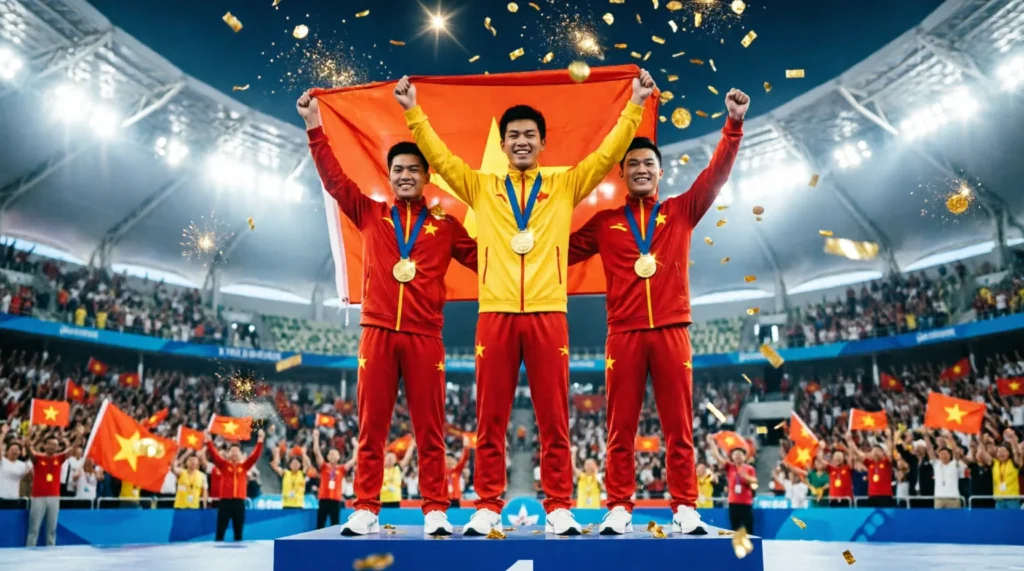
Quick answer: The phrase “Vietnam won the sea games” is grammatically incorrect because it uses lowercase letters for proper nouns. The correct form is “Vietnam won the SEA Games” or “Vietnam won the Southeast Asian Games,” as both “SEA” (an acronym) and “Games” (part of the official event title) must be capitalized.
Many writers stumble over this phrase because they treat “sea games” as a generic description of athletic competitions held near water, rather than recognizing it as the specific proper name of a major international sporting event. This confusion leads to capitalization errors that undermine the professionalism of sports reporting, academic papers, and casual social media posts alike. Understanding the distinction between common nouns and proper nouns is essential for accurate writing about international events.
| Term | Meaning / When to use | Example sentence |
|---|---|---|
| SEA Games | The official proper noun for the Southeast Asian Games; always capitalize both “SEA” and “Games.” | Vietnam topped the medal tally at the 31st SEA Games. |
| sea games | An incorrect lowercase formulation; never use this unless referring generically to games played in the ocean (which is rare). | Incorrect: vietnam won the sea games last year. |
| Southeast Asian Games | The full formal name of the event; capitalize all major words. | The Southeast Asian Games are held every two years. |
When to Use “SEA Games”
You should use the term “SEA Games” whenever you are referring to the biennial multi-sport event involving participants from the current eleven countries of Southeast Asia. This is a proper noun, which means it refers to a unique, specific entity. In English grammar, proper nouns always require capitalization. The acronym “SEA” stands for Southeast Asian, and “Games” is part of the official title, similar to how we write “Olympic Games” or “Asian Games.”
I have edited countless sports articles where journalists hastily typed “sea games” in lowercase, likely because they were thinking of the word “sea” as a common noun describing water. However, in this context, “SEA” is an initialism. Failing to capitalize it signals to the reader that the writer does not understand the subject matter. It is akin to writing “united nations” instead of “United Nations.”
Consider these correct usage examples:
- In a news headline: “Vietnam Wins Gold in Swimming at the 31st SEA Games.”
- In a formal report: “The host nation, Vietnam, demonstrated superior performance across multiple disciplines during the SEA Games.”
- In a social media post: “So proud of our athletes for dominating the SEA Games this year! 🇻🇳🥇”
The consistency of capitalization helps maintain the authority of your writing. When you refer to the event, you are invoking a specific brand and organization. The Wikipedia entry on Vietnam highlights the country’s significant role in regional cooperation and cultural events, including hosting major tournaments like the SEA Games, which underscores the importance of referring to these events with their proper titles.
When to Use “Southeast Asian Games”
While “SEA Games” is the commonly accepted shorthand, there are times when you should use the full name: “Southeast Asian Games.” This is particularly true in formal introductions, academic writing, or when addressing an audience that may not be familiar with the acronym. Just like the abbreviated form, the full name is a proper noun and requires capitalization of the principal words.
Using the full name adds clarity and gravitas. It removes any ambiguity for readers who might not immediately recognize “SEA” as an acronym for Southeast Asian. In my experience editing international sports coverage, I often recommend using the full name on the first mention in an article, followed by the acronym in parentheses, and then using the acronym for subsequent references. This is a standard journalistic practice that ensures accessibility without sacrificing brevity later in the text.
Here are examples of how to correctly integrate the full name:
- In an introductory paragraph: “The 31st Southeast Asian Games (SEA Games) were held in Hanoi, Vietnam, marking a significant moment for regional sports diplomacy.”
- In a historical overview: “Since its inception, the Southeast Asian Games has grown from a small regional competition to a major sporting spectacle.”
- In a comparative analysis: “Performance metrics from the Southeast Asian Games indicate a rising trend in aquatic sports participation among member nations.”
It is crucial to remember that “Games” remains capitalized in both the full and abbreviated forms. This is because it is part of the official title. You would not write “the olympic games” in lowercase, and the same rule applies here. The event is not just any games that happen to be in Southeast Asia; it is the Southeast Asian Games.
How to Remember the Difference
The most effective way to remember the correct capitalization is to treat “SEA Games” as a brand name. Think of it like “iPhone” or “Coca-Cola.” You would not write “iphone” or “coca-cola” in a professional document because those are proprietary names. Similarly, “SEA Games” is the proprietary name of a specific sporting event organized by the Southeast Asian Games Federation.
A simple mnemonic device is to think of the acronym SEA as standing for Specific Event Acronym. Since it is an acronym, it must be in all caps. Then, remember that Games is part of the title, so it gets a capital letter too. If you can replace “SEA Games” with “Olympics” in your sentence and it still makes sense, you know you are dealing with a proper noun that requires capitalization.
Another trick is to visualize the logo. The official logo of the event always features the text “SEA Games” with prominent capitalization. If you picture the banner hanging in the stadium, you will see the capitals. This visual association can help prevent the lazy habit of typing everything in lowercase. I often tell my students: if it has a logo, it has capitals.
Furthermore, consider the geographic specificity. “Sea” is a common noun, but “SEA” in this context is a geopolitical descriptor. It refers to a specific region of the world. Just as you capitalize “Europe” or “Asia,” you must capitalize the acronym that represents the region’s sporting body. This mental shift from “water” to “region” is key to correcting the error.
Common Mistakes and Exceptions
The most frequent mistake is writing “vietnam won the sea games” entirely in lowercase or with only the first letter capitalized (“Sea games”). Both are incorrect. Another common error is hyphenating it incorrectly, such as “SEA-Games,” which is not the standard styling. The official styling is two separate words: “SEA Games.”
There is also a tendency to pluralize “Game” incorrectly. Some writers might write “SEA Game” when referring to the entire event. This is wrong. The event consists of many games, so the title is plural: “Games.” You participate in the “SEA Games,” not the “SEA Game.” However, you can refer to a single match within the event as a “game,” but that is a different context. For example, “The volleyball game was intense,” is correct, but “The SEA Game was held in Hanoi,” is incorrect.
US vs. UK spelling differences do not apply to the proper noun itself. Whether you are writing for an American or British audience, “SEA Games” remains spelled and capitalized the same way. However, surrounding verbs might change. For instance, a UK writer might say “Vietnam have won the SEA Games,” treating the team as a plural collective, while a US writer would say “Vietnam has won the SEA Games,” treating the country as a singular entity. But the name of the event itself is immutable.
An exception to the capitalization rule would only exist if you were using the words in a purely descriptive, non-proper sense, which is extremely rare. For example, if you were writing a poetic description of children playing tag on a beach, you might write, “They enjoyed their little sea games under the sun.” Here, “sea games” is not a reference to the sporting event but a literal description of games by the sea. However, in the context of sports journalism or any discussion about Vietnam’s athletic achievements, this exception is irrelevant. You are almost certainly referring to the proper noun.
Games encompass a wide range of structured play, but when attached to a specific regional identifier like “SEA,” it becomes a titled event. This distinction is vital for maintaining clarity in communication. Mislabeling the event can lead to confusion with other aquatic competitions or local beach festivals.
Frequently Asked Questions
Is it “SEA Games” or “Sea Games”? It is always “SEA Games” with “SEA” in all capital letters because it is an acronym for Southeast Asian, and “Games” capitalized because it is part of the proper title.
Do I need to capitalize “games” if I just say “the games”? If you are referring specifically to the SEA Games in a context where it is clear, you can lowercase “games” in informal internal notes, but in published writing, it is safer to capitalize it if it stands in for the full proper noun, or simply use “the event.” However, strictly speaking, “the games” is a common noun phrase unless defined otherwise.
Why is “SEA” capitalized but not “Southeast Asian” in the acronym? “SEA” is an initialism, where each letter stands for a word (Southeast Asian). Initialisms are always capitalized. When you write out the full words “Southeast Asian,” you capitalize them because they are part of the proper noun phrase “Southeast Asian Games.”
Can I use “SEAG” as an abbreviation? No, “SEAG” is not a recognized or standard abbreviation. The universally accepted short form is “SEA Games.” Using non-standard abbreviations can confuse readers and hurt the credibility of your writing.

Kevin Sanchez holds a Master’s degree in English Linguistics from the University of California, where he cultivated a deep appreciation for the intricacies of language. With over 10 years of experience in the field, Kevin specializes in the nuances of English spelling, particularly the evolution of spelling conventions over time. His fascination with how English words have transformed through cultural and technological influences led him to become a prominent voice at SpellRightDaily. Kevin produces content focused on historical spelling variations and their contemporary implications, offering readers insightful comparisons of British and American English. Beyond this, Kevin has a keen interest in educating readers about the rules that govern standard spelling and the exceptions that often lead to confusion. His articles frequently feature tips for mastering complex spelling patterns and understanding the etymology of perplexing words. Kevin’s dedication to clarity and accessibility makes his contributions invaluable to both casual readers and English language professionals.