

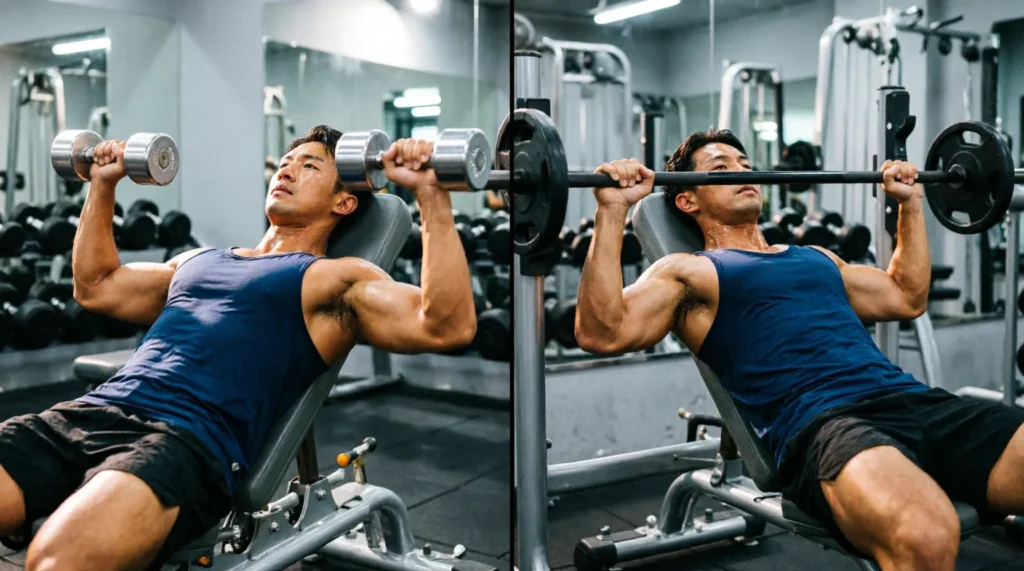
Quick answer: The correct spelling is flies (as in chest flies), not “flys.” However, if you are asking about exercise order, most strength coaches recommend performing the chest press first when your goal is maximum strength or muscle growth, as it allows you to lift heavier loads with fresh energy.
It is surprisingly common to see gym-goers and fitness writers stumble over two distinct issues: the grammatical spelling of “flies” versus “flys,” and the strategic debate of whether to prioritize isolation movements like flies or compound movements like the chest press. This confusion often stems from a mix of linguistic uncertainty and conflicting fitness advice found online. Clarifying both the language and the logic behind your workout structure can help you train more effectively and communicate more professionally in fitness communities.
| Term | Meaning / When to use | Example sentence |
|---|---|---|
| Flies | The correct plural noun for the exercise “chest fly,” or the third-person singular verb for insect movement. | “I added three sets of dumbbell flies to my routine.” |
| Flys | An incorrect spelling. It is never correct in standard English for either the exercise or the insect. | “Avoid writing ‘chest flys‘ in your training log.” |
| Chest Press | A compound pushing movement involving the pectorals, shoulders, and triceps. | “Start your workout with a heavy chest press to maximize strength gains.” |
When to use “Flies”
The word “flies” is the standard plural form of the noun “fly” and the third-person singular present tense of the verb “to fly.” In the context of fitness, it refers to the exercise known as the “chest fly” or “pec fly.” This movement involves opening the arms wide to stretch the pectoral muscles and then bringing them together in an arc, mimicking the motion of hugging a large tree.
the chest is the anterior part of the thorax, containing the pectoral muscles that are primarily targeted during this exercise. Because the movement isolates these muscles through a wide range of motion, it is technically referred to as a “fly.” When you perform multiple sets or refer to the exercise in general, you must use the plural “flies.”
Here are real-world examples of how to use it correctly:
- In a training log: “Monday: Bench press 3×5, Dumbbell flies 3×12.”
- In a text to a gym partner: “Hey, are we doing cable flies or machine presses today?”
- In a fitness blog post: “Proper form on chest flies requires a slight bend in the elbows to protect the shoulder joint.”
Using “flys” in any of these contexts is a grammatical error that can undermine your credibility, especially if you are a trainer or content creator. The rule is simple: if it rhymes with “ties” or “pies,” it ends in “-ies.”
When to use “Chest Press First”
The phrase “chest press first” refers to a specific strategic decision in workout programming. It means prioritizing the compound pressing movement—such as the barbell bench press, dumbbell press, or machine press—before moving on to isolation exercises like flies. This approach is grounded in the principle of energy management and neuromuscular efficiency.
A press in physical exercise generally refers to a movement where weight is pushed away from the body, engaging multiple muscle groups and joints. Because the chest press is a compound movement, it requires significant central nervous system (CNS) drive and stability. Performing it when you are freshest allows you to lift heavier weights safely, which is a key driver for mechanical tension and muscle hypertrophy.
Consider these scenarios where prioritizing the chest press is the superior choice:
- For Strength Goals: If you are training for a powerlifting meet or simply want to increase your one-rep max on the bench press, you must do it first. Fatigue from prior isolation work will reduce your force output.
- For General Hypertrophy: Most lifters get the best return on investment from compound lifts. By pressing first, you ensure that the largest amount of muscle mass is stimulated under the heaviest load.
- For Safety: Heavy pressing requires strict form and core stability. If you pre-exhaust your chest with flies, your stabilizer muscles may fatigue, increasing the risk of injury during heavy presses.
Example of correct application in a program:
- Workout A: Barbell Bench Press (4×6), Incline Dumbbell Press (3×8), Cable Flies (3×15).
- Email to a client: “Please ensure you complete your heavy chest press sets before moving to the isolation work. Your energy levels need to be high for the compound lifts.”
How to remember the difference
Remembering the distinction between the spelling of “flies” and the strategic order of “chest press first” can be simplified with two distinct mental hooks.
For the spelling, think of the insect. A single insect is a fly. Two insects are flies. You would never write “two flys” when talking about bugs, so do not write it when talking about exercises. The exercise is named after the motion, which resembles the wings of a fly opening and closing. Therefore, the plural remains flies. A simple mnemonic: “If it’s more than one, add the -es, not the -s.”
For the workout order, remember the acronym C.P.F.: Compound, Power, First. Compound movements require power. Power requires freshness. Therefore, compounds come first. Alternatively, think of your workout like a meal: the main course (the heavy press) comes before the dessert (the isolation fly). You wouldn’t eat dessert first and then expect to have room for a steak; similarly, you shouldn’t exhaust your chest with flies and then expect to press heavy weights.
Common mistakes and exceptions
One of the most frequent errors I see in amateur fitness programs and social media captions is the misspelling “flys.” This error often appears in hashtags, such as #chestflys, which perpetuates the mistake across platforms. While it may seem minor, consistent misspelling can signal a lack of attention to detail, which is crucial for personal trainers who rely on professional communication.
Another common mistake is reversing the workout order without a specific purpose. Some advanced techniques, such as “pre-exhaustion,” intentionally involve performing isolation exercises like flies before compound movements like presses. The theory is that by fatiguing the target muscle (the pecs) first, you force it to work harder during the compound lift, potentially reducing the contribution of secondary muscles like the triceps. However, this is an advanced technique and should not be the default for most lifters. For the vast majority of people, especially beginners and intermediates, pressing first is the safer and more effective route.
There are also regional differences in terminology that can cause confusion. In some gyms, the term “fly” is replaced by “flye” or “flie,” though these are archaic or incorrect variants. Stick to “fly” for the singular and “flies” for the plural. Additionally, while US English and UK English differ on many spelling conventions (such as color/colour or center/centre), they agree on the plural of fly. Both varieties use flies.
Real-world correction examples:
- Incorrect Resume Line: “Designed weekly routines including bench press and chest flys.”
- Correction: “Designed weekly routines including bench press and chest flies.”
- Incorrect Text Message: “I’m sore from the flys I did yesterday.”
- Correction: “I’m sore from the flies I did yesterday.”
- Incorrect Program Note: “Do 3 sets of flys before pressing.”
- Correction: “Do 3 sets of flies before pressing” (only if using pre-exhaustion methodology).
Frequently Asked Questions
Is “flys” ever correct in English? No, “flys” is never correct in standard modern English. The plural of the noun “fly” is always “flies,” and the third-person singular verb form is also “flies.”
Can I do flies before chest press? You can, but it is generally not recommended for strength or maximal muscle growth. Doing flies first is a technique called “pre-exhaustion,” which is used by advanced lifters to isolate the chest, but it will limit the weight you can press safely.
Why do people spell it “flys”? People often misspell it as “flys” because many English nouns simply add an “s” to become plural (e.g., cat/cats). However, words ending in a consonant + “y” typically change the “y” to “i” and add “es” (e.g., baby/babies, fly/flies).
Which is better for building muscle: flies or chest press? The chest press is generally better for overall muscle mass and strength because it allows you to lift heavier loads and engage more muscle fibers. Flies are excellent for stretching the muscle and adding volume, but they should usually complement, not replace, pressing movements.

Anthony Perez, a PhD in Applied Linguistics from the University of Toronto, has dedicated over 12 years to studying the cognitive aspects of language acquisition, with a special focus on English spelling conventions. His journey into the world of spelling and word comparisons was sparked by his research on how non-native speakers adapt to English orthography. At SpellRightDaily, Anthony shares his insights through content that explores the science behind spelling acquisition and offers strategies for overcoming common traps in English spelling. His articles are particularly aimed at learners who are new to English, although his engaging explanations also attract native speakers interested in refining their spelling skills. Anthony’s research-driven approach provides an evidence-based perspective that enriches the site’s resources, offering readers not just the ‘how’ but the ‘why’ behind effective spelling strategies. His work at SpellRightDaily combines academic rigor with practical application, making complex concepts accessible to a broad audience.