

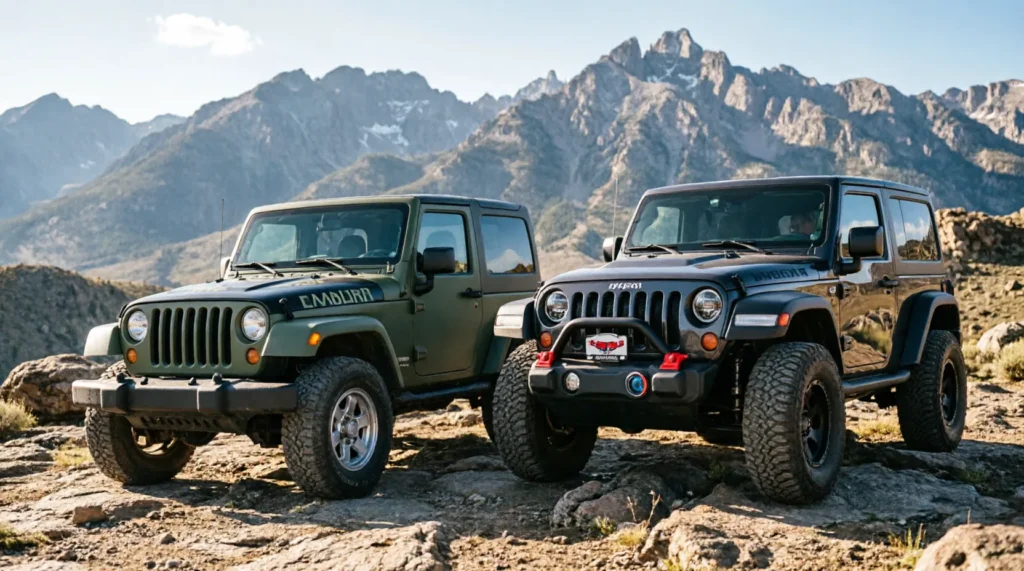
Quick answer: “Willys” and “Rubicon” are not interchangeable words or spellings; they are distinct trim levels for the Jeep Wrangler. The Willys is a mid-tier, value-oriented package focused on off-road aesthetics and basic capability, while the Rubicon is the top-tier, factory-equipped extreme off-roader with heavy-duty axles, locking differentials, and superior articulation.
Many Jeep shoppers stumble over these names because both evoke rugged, military-grade heritage. The confusion often stems from marketing overlap: both trims feature aggressive tires, blacked-out badges, and rock rails. However, treating them as equals is a costly mistake. Understanding the mechanical and functional gap between them ensures you pay only for the capability you actually need.
| Term | Meaning / When to use | Example sentence |
|---|---|---|
| Willys | A mid-level Wrangler trim honoring the original WWII jeep, offering off-road looks, limited-slip rear differential, and rock rails without the heavy-duty axle hardware. | “I chose the Willys because I want the classic black hood decal and all-terrain tires for weekend camping, but I don’t plan on crawling over boulders.” |
| Rubicon | The highest-capability Wrangler trim, named after the Rubicon Trail, featuring Dana 44 axles, electronic locking differentials, sway bar disconnect, and 33-inch tires from the factory. | “If you intend to tackle the Moab slickrock, you need the Rubicon’s locking differentials and increased ground clearance to avoid getting stuck.” |
When to use Willys
The Willys trim is designed for the enthusiast who wants the look of a serious off-roader and enough capability to handle forest service roads, muddy trails, and light rock gardening. It sits above the base Sport model but below the Sahara and Rubicon in the hierarchy.
I see this error constantly in buyer forums: people assume the Willys is just a “budget Rubicon.” It is not. It is a distinct package that prioritizes aesthetic heritage and moderate utility. The Willys package typically includes 17-inch wheels with all-terrain tires, a limited-slip rear differential, rock rails, and the iconic “Willys” hood decal. It lacks the heavy-duty Dana 44 front and rear axles found in the Rubicon.
Use the term “Willys” when referring to:
- Buyers who prioritize style and moderate off-road use over extreme technical crawling.
- Vehicles equipped with the heritage package, including black accents and specific badging.
- Scenarios where cost savings are preferred over maximum mechanical articulation.
For example, in a recent client consultation for a fleet purchase, the manager wanted vehicles that looked tough for brand image but would primarily drive on paved roads with occasional gravel detours. I recommended the Willys. As noted in historical contexts, the name pays homage to the original Difference in military utility vehicles, bridging the gap between civilian comfort and military heritage without the extreme cost of full tactical specs.
Example sentences for correct usage:
- “The Willys trim gives you the rock rails and aggressive tires, which is perfect for our county maintenance crews who need to access remote sites.”
- “I upgraded my Sport to the Willys package specifically for the limited-slip differential, which helps significantly in wet grass and mild mud.”
- “Don’t expect the Willys to perform like a Rubicon on steep, uneven terrain; it lacks the locking differentials required for that level of traction.”
When to use Rubicon
The Rubicon is the benchmark for factory-built off-road capability. Named after the infamous Rubicon Trail in California, this trim is engineered for low-speed, high-articulation rock crawling. It is not merely a cosmetic upgrade; it is a mechanical overhaul.
Use the term “Rubicon” when referring to:
- Serious off-roaders who plan to engage in rock crawling, deep sand, or severe mud.
- Vehicles equipped with electronic locking front and rear differentials and an electronic sway bar disconnect system.
- Situations where maximum wheel articulation and axle strength are non-negotiable.
The Rubicon’s defining features are its Dana 44 heavy-duty axles, 4:10 gear ratio (in many model years), and the ability to lock both axles simultaneously. This allows power to be sent to all four wheels even if three are suspended in the air. The sway bar disconnect feature allows for significantly increased wheel travel, keeping tires in contact with uneven surfaces.
In my experience editing automotive technical manuals, confusing these two trims leads to serious misrepresentation of vehicle capabilities. A writer might claim a Willys can “handle any trail,” which is factually incorrect compared to a Rubicon. The distinction is clear in the engineering: the Rubicon is built to survive impacts and torque loads that would damage a standard axle. According to the concept of Between comparative mechanical standards, the Rubicon occupies the upper echelon of consumer off-road vehicles, whereas the Willys serves as a capable entry-point.
Example sentences for correct usage:
- “We took the Rubicon up the Elephant Hill trail, and the locking differentials made the difference between getting stuck and powering through.”
- “If you are modifying your Jeep for serious overlanding, start with a Rubicon because the heavy-duty axles can handle larger tires and heavier armor.”
- “The Rubicon’s sway bar disconnect is essential for maintaining traction on side-hill traverses where body roll would otherwise lift a wheel off the ground.”
How to remember the difference
Memory tricks are essential for keeping these trims straight, especially when speaking with clients or writing specifications. Here is the editor’s trick I use:
Willys = “Wanting Looks & Light Yielding Surfaces” The Willys is about the look (heritage decals, black wheels) and handling light off-road conditions like dirt, gravel, and mild mud. It yields to extreme obstacles because it lacks the locking hardware.
Rubicon = “Rugged Undercarriage Breaks Obstacles Completely On-Nature” The Rubicon is built with a rugged undercarriage (heavy axles) designed to break through obstacles like large rocks and deep ruts. It dominates nature rather than just navigating it.
Another simple mnemonic:
- Willys has two L’s. Think of Limited-slip and Light duty.
- Rubicon has four syllables (Ru-bi-con). Think of 4-wheel lock and 4x4 dominance.
I once corrected a brochure draft where the author claimed the Willys had “Rubicon-level crawling ability.” I marked it up with a red pen: “No. Willys has style. Rubicon has steel. Do not confuse the paint job with the powertrain.”
Common mistakes and exceptions
Even experienced writers and salespeople mix these terms up. Here are the most frequent errors I encounter in manuscripts and marketing copy.
Mistake 1: Assuming all blacked-out Jeeps are Rubicons. Jeep offers the “Blackout Package” on various trims, including the Willys. A Willys with a blackout package looks nearly identical to a Rubicon from ten feet away. Always check the badging on the hood or the door. If it says “Willys,” it does not have locking differentials, regardless of how aggressive the tires look.
Mistake 2: Believing the Willys has locking differentials. This is the most dangerous misconception for buyers. The Willys comes with a limited-slip rear differential (on most model years). This is not a locker. A limited-slip diff sends some power to the wheel with traction, but a locker mechanically forces both wheels to spin at the same speed. In deep mud or on slick rock, a locker is superior. Never tell a customer the Willys “locks” unless you are referring to the optional rear locker available on some higher-tier packages, which is still not the standard dual-locker setup of the Rubicon.
Mistake 3: Ignoring the Sway Bar Disconnect. The Rubicon’s electronic sway bar disconnect is a game-changing feature for articulation. The Willys does not have this. Without it, the Willys will lift a wheel much sooner on uneven terrain, reducing traction. If you are writing about off-road performance, you must mention this mechanical disparity.
US vs UK Differences: While Jeep is a global brand, the Willys and Rubicon trims are primarily marketed in North America. In other markets, trim names may vary (e.g., “Overland” or “Sahara” might hold different positions in the hierarchy). However, the mechanical distinction remains: the Rubicon badge always signifies the highest off-road hardware package available in that region. In the UK, where off-roading often involves green lanes rather than rock crawling, the Rubicon is still recognized as the ultimate trail-rated machine, though the Willys name may be less common depending on the import year.
Frequently Asked Questions
Is the Willys better than the Rubicon for daily driving? Yes, for many drivers, the Willys is better for daily use because it often comes with slightly smaller, lighter tires and a simpler drivetrain, resulting in better fuel economy and a quieter ride on pavement compared to the Rubicon’s aggressive setup.
Can you add Rubicon features to a Willys later? You can add cosmetic features like decals and wheels, but you cannot easily retrofit the Rubicon’s heavy-duty Dana 44 axles, locking differentials, and sway bar disconnect system. These are integral structural components that require extensive fabrication to swap.
Does the Willys have the same engine as the Rubicon? Generally, yes. Both trims usually share the same engine options (such as the 3.6L V6 or 2.0L Turbo), so horsepower and torque figures are similar. The difference lies entirely in the transmission gearing, axles, and suspension components, not the engine itself.
Why is it called the Rubicon? It is named after the Rubicon Trail in the Sierra Nevada mountains of California, one of the most famous and difficult off-road trails in the world. Jeep uses this name to signify that the vehicle is capable of conquering extreme terrain straight from the factory.

Anthony Perez, a PhD in Applied Linguistics from the University of Toronto, has dedicated over 12 years to studying the cognitive aspects of language acquisition, with a special focus on English spelling conventions. His journey into the world of spelling and word comparisons was sparked by his research on how non-native speakers adapt to English orthography. At SpellRightDaily, Anthony shares his insights through content that explores the science behind spelling acquisition and offers strategies for overcoming common traps in English spelling. His articles are particularly aimed at learners who are new to English, although his engaging explanations also attract native speakers interested in refining their spelling skills. Anthony’s research-driven approach provides an evidence-based perspective that enriches the site’s resources, offering readers not just the ‘how’ but the ‘why’ behind effective spelling strategies. His work at SpellRightDaily combines academic rigor with practical application, making complex concepts accessible to a broad audience.