

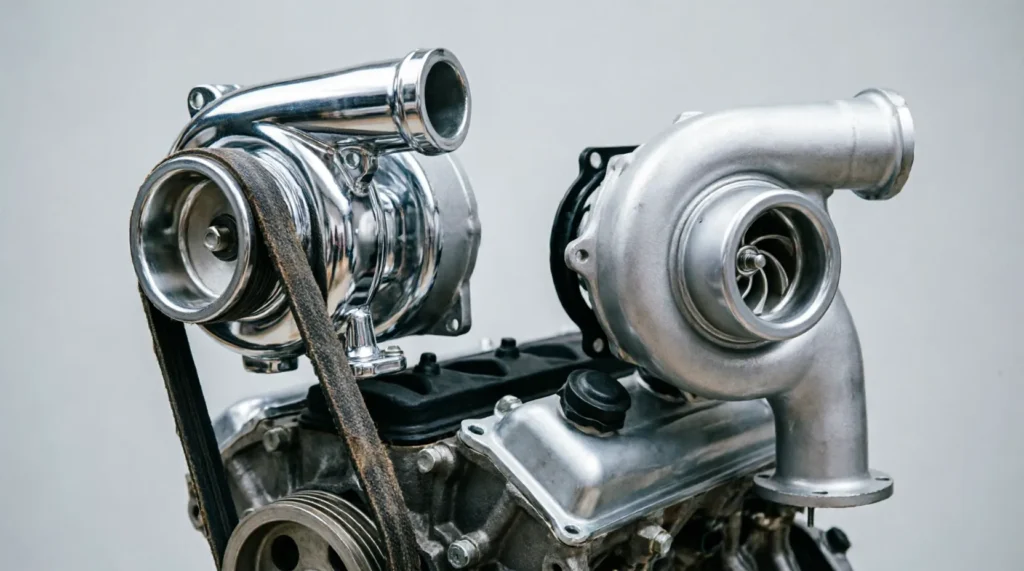
Quick answer: A supercharger is a broad category of engine-driven air compressors that force more air into an engine, while a ProCharger is a specific brand of centrifugal supercharger. All ProChargers are superchargers, but not all superchargers are ProChargers. The difference is between a general technology type and a proprietary manufacturer.
Many car enthusiasts and mechanics confuse these two terms because they sound similar and both relate to boosting engine power. However, understanding the distinction is crucial when discussing modifications, purchasing parts, or troubleshooting performance issues. This confusion often stems from marketing language that treats “ProCharger” as synonymous with high-quality forced induction, leading many to use the brand name as a generic term for any belt-driven compressor.
| Term | Meaning / When to use | Example sentence |
|---|---|---|
| Supercharger | Any engine-driven air compressor that increases manifold pressure | “I installed a supercharger on my Mustang to gain 150 horsepower.” |
| ProCharger | A specific brand of centrifugal supercharger manufactured by ProCharger Systems | “My friend’s Camaro has a ProCharger kit that spools up quickly at high RPM.” |
When to use supercharger
Use the term “supercharger” when referring to the general category of forced induction devices that are mechanically driven by the engine itself, typically via a belt connected to the crankshaft. This term encompasses three main types: roots-style, twin-screw, and centrifugal superchargers. Each type operates differently but shares the common characteristic of being directly powered by engine rotation rather than exhaust gases like a turbocharger.
According to Wikipedia, superchargers provide immediate boost pressure since they are directly linked to engine speed, making them particularly effective for low-end torque delivery. This direct mechanical connection means that superchargers respond instantly to throttle input, providing linear power delivery throughout the RPM range.
Consider these real-world examples where “supercharger” is the correct term:
- In a repair manual: “Check the supercharger belt tension every 15,000 miles to ensure proper operation.”
- During a dyno session: “The supercharger adds approximately 30% more air volume to the combustion chamber.”
- When comparing technologies: “Unlike turbochargers that rely on exhaust flow, superchargers draw power directly from the crankshaft.”
I have seen countless forum posts where enthusiasts incorrectly refer to any forced induction system as a “supercharger” when they actually have a turbocharger installed. This fundamental misunderstanding can lead to incorrect maintenance procedures and parts ordering. Always verify whether your forced induction system is engine-driven (supercharger) or exhaust-driven (turbocharger) before using either term.
When to use ProCharger
Use “ProCharger” specifically when referring to products manufactured by ProCharger Systems, a company specializing in centrifugal supercharger kits for various vehicle platforms. ProCharger is a registered trademark and should only be used when discussing their particular brand of superchargers, which feature unique design elements such as self-contained oiling systems and specific impeller designs.
The key distinction here is that ProCharger represents one manufacturer’s approach to centrifugal supercharging technology. Their systems are known for high efficiency at higher RPM ranges and relatively compact packaging compared to some roots-style alternatives. When you see “ProCharger” capitalized, it indicates a specific product line rather than a general technology category.
Here are appropriate contexts for using “ProCharger”:
- When discussing specific installations: “The ProCharger F-1A unit provides excellent top-end power for track applications.”
- During warranty discussions: “Contact ProCharger customer service regarding your intercooler upgrade compatibility.”
- When comparing brands: “While Vortech and ProCharger both make centrifugal units, their mounting configurations differ significantly.”
In my years reviewing performance modifications, I have noticed that many retailers and installers incorrectly use “ProCharger” as a generic term for any centrifugal supercharger. This practice not only violates trademark guidelines but also creates confusion for consumers trying to understand their options. Always use the brand name only when specifically referring to ProCharger Systems products, and use “centrifugal supercharger” when discussing the technology type generally.
How to remember the difference
Think of it this way: “Supercharger” is like “smartphone,” while “ProCharger” is like “iPhone.” One describes the entire category of technology, while the other refers to a specific brand within that category. Just as all iPhones are smartphones but not all smartphones are iPhones, all ProChargers are superchargers but not all superchargers are ProChargers.
Another helpful mnemonic involves the capitalization: “Supercharger” begins with a lowercase ‘s’ when used generically, indicating it is a common noun describing a type of device. “ProCharger” always begins with a capital ‘P’ because it is a proper noun representing a specific company’s trademarked product line. This simple capitalization rule can help you determine which term to use in any given context. For more, see Difference.
I recommend visualizing the relationship as a family tree: “Forced Induction” sits at the top, branching into “Turbochargers” and “Superchargers.” Under “Superchargers,” you find three branches: “Roots-type,” “Twin-screw,” and “Centrifugal.” Finally, under “Centrifugal,” you find various manufacturers including “ProCharger,” “Vortech,” and others. This hierarchical understanding prevents the common mistake of treating brand names as technology categories.
Common mistakes and exceptions
The most frequent error occurs when people use “ProCharger” to describe any centrifugal supercharger, regardless of manufacturer. This mistake appears regularly in online forums, social media posts, and even some automotive journalism. For example, someone might write, “I need to rebuild my ProCharger,” when they actually have a Vortech unit installed. This misidentification can lead to ordering incorrect replacement parts and receiving incompatible technical support.
Another common confusion involves the spelling and capitalization of “ProCharger.” The correct form is always “ProCharger” with a capital ‘P’ and ‘C,’ never “procharger” or “Pro Charger.” Trademark law requires proper capitalization to maintain brand distinction, and using incorrect forms can dilute the trademark’s legal protection. I have reviewed numerous product listings where sellers incorrectly wrote “procharger” in lowercase, potentially creating legal vulnerabilities for both the seller and the manufacturer.
Regional differences do not significantly affect this terminology, as both “supercharger” and “ProCharger” are used consistently across English-speaking markets. However, some European enthusiasts may be less familiar with the ProCharger brand specifically, as centrifugal superchargers have historically been less popular in European tuning scenes compared to turbochargers. This geographic variation means that international discussions about forced induction may require additional clarification about specific brands and technologies.
One exception worth noting involves historical usage. In the early days of hot rodding, various manufacturers produced centrifugal superchargers under different names, and some older enthusiasts may use “ProCharger” colloquially to refer to any belt-driven centrifugal unit. While this informal usage persists in certain circles, professional automotive writing and technical documentation should always maintain the distinction between generic technology terms and specific brand names.
Frequently Asked Questions
Is a ProCharger better than other superchargers? This depends on your specific application and goals. ProCharger centrifugal units excel at high-RPM power delivery and offer compact packaging, but roots-style superchargers may provide better low-end torque for street driving. The “better” option varies based on your vehicle, driving style, and power goals.
Can I call any centrifugal supercharger a ProCharger? No, this is incorrect usage. ProCharger is a specific brand name, and using it to describe other manufacturers’ products is both technically inaccurate and potentially problematic from a trademark perspective. Use “centrifugal supercharger” for the general technology type.
Do all superchargers work the same way? No, there are three main types: roots-style, twin-screw, and centrifugal. Each operates differently and offers distinct characteristics regarding power delivery, efficiency, and installation requirements. Roots and twin-screw units provide more low-end boost, while centrifugal units build boost progressively with RPM.
Why do people confuse ProCharger with supercharger? The confusion stems from ProCharger’s market prominence in the centrifugal supercharger segment and marketing that emphasizes their brand name. Additionally, many enthusiasts encounter ProCharger products first and mistakenly assume the brand name represents the entire technology category rather than one manufacturer’s implementation.

Anthony Perez, a PhD in Applied Linguistics from the University of Toronto, has dedicated over 12 years to studying the cognitive aspects of language acquisition, with a special focus on English spelling conventions. His journey into the world of spelling and word comparisons was sparked by his research on how non-native speakers adapt to English orthography. At SpellRightDaily, Anthony shares his insights through content that explores the science behind spelling acquisition and offers strategies for overcoming common traps in English spelling. His articles are particularly aimed at learners who are new to English, although his engaging explanations also attract native speakers interested in refining their spelling skills. Anthony’s research-driven approach provides an evidence-based perspective that enriches the site’s resources, offering readers not just the ‘how’ but the ‘why’ behind effective spelling strategies. His work at SpellRightDaily combines academic rigor with practical application, making complex concepts accessible to a broad audience.