

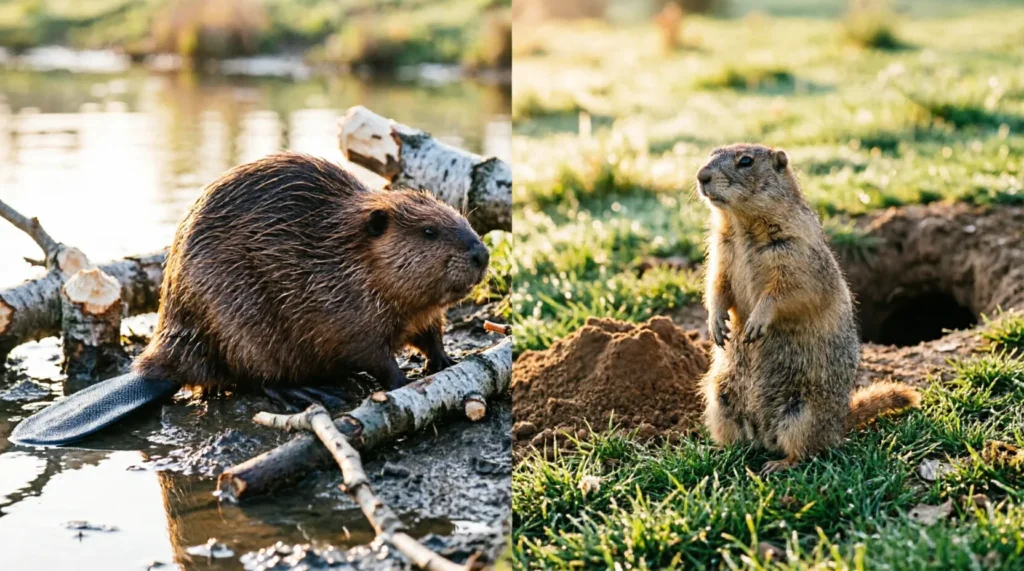
Quick answer: A beaver is the large, semi-aquatic rodent with a flat, paddle-shaped tail that fells trees and builds dams; a groundhog (also called a woodchuck) is the smaller, burrowing marmot with a stubby, furry tail. If the animal is engineering the water, write “beaver”; if it is excavating the lawn, write “groundhog.”
I have edited nature-center newsletters, campground circulars, and wildlife-control brochures for more than a decade, and no pair of nouns gets swapped on my desk more often than these two. Both are stocky, brown rodents that haunt the same North American creeks, woodlots, and cul-de-sacs, so the mix-up is understandable. Philosophers and mathematicians have entire treatises on what a difference really is, but this one collapses into three field marks you can check from your porch: the tail, the habitat, and the size.
| Term | Meaning / When to use | Example sentence |
|---|---|---|
| Beaver | The large, semi-aquatic dam-builder (genus Castor) with a flat, scaly, hairless tail, webbed hind feet, and orange incisors. Use it when the animal is working in water. | “A beaver felled three birches across the creek overnight.” |
| Groundhog | The stocky, burrowing marmot (Marmota monax), also called a woodchuck, with a short furry tail and clawed forefeet. Use it when the animal is digging in dry ground. | “A groundhog dug a den under the porch, and now the steps sag.” |
When to use beaver
Use beaver when the animal in your sentence is semi-aquatic and constructive: it dams a creek, stacks branches into a lodge, slaps a flat paddle tail on the water, or gnaws trees down to pencil-sharpened stumps. Beavers are the second-largest rodents on the planet, adults run 35 to 70 pounds, and every inch of them is built for water: webbed hind feet, valved nostrils, and a rudder-like tail.
Field marks that justify the word “beaver”:
- A tail like a black, scaly paddle — flat, broad, and completely hairless.
- A body the size of a carry-on suitcase, riding low in the water, often towing a branch.
- Gnawed willows, birches, or aspens near a pond, cut at the classic sharpened-point angle.
- A dam of sticks and mud raising the water level upstream.
Correct usage, from manuscripts I have actually cleaned up:
- “A beaver dammed the culvert and flooded the lower pasture.” (Water engineering = beaver.)
- “We watched the beaver slap its tail and vanish in a splash.” (The tail slap = beaver.)
- “By morning the beavers had gnawed the willow screen to stubble.” (Tree-felling = beaver.)
One correction still sticks with me. A campground manager emailed me, “A beaver keeps digging holes under cabin 4, please advise.” I changed “beaver” to “groundhog” and saved her from a very confused pest-control contractor. Beavers do not dig dens under cabins; they build lodges in ponds. When the complaint involves dry dirt, the word you want is not beaver.
When to use groundhog
Use groundhog when the animal is terrestrial and digs instead of builds: it burrows under decks, sheds, and sidewalks, whistles from a fence post, and suns itself on a mowed bank. According to Wikipedia’s Groundhog entry, the species Marmota monax is a true marmot in the squirrel family — unusual among marmots for preferring lowland fields to mountain meadows — and a genuine hibernator whose body temperature collapses to near freezing each winter.
Field marks that justify the word “groundhog”:
- A short, bushy, fur-covered tail, closer to a squirrel’s stub than a paddle.
- A compact 5 to 13 pounds — stout, but nowhere near beaver bulk.
- Clawed, dirt-stained forefeet built for excavation, not swimming.
- A mound of fresh dirt at a den entrance, often tucked under a structure.
Correct usage:
- “A groundhog burrowed under the shed, and the floorboards now bounce.”
- “The groundhog whistled twice from the fence line and dropped into its hole.” (The nickname “whistle-pig” is earned.)
- “Punxsutawney Phil, the world’s most famous weather forecaster, is a groundhog — never a beaver.”
A reader once texted me a photo of a cratered lawn with the caption “beaver did this lol.” I answered with one word — groundhog — followed by a photo of a paddle tail for comparison. The crater sat forty feet from the nearest water, and beavers do not commute that far to landscape a yard.
How to remember the difference
The names already carry the rule; you only have to take them literally:
- Groundhog hugs the ground. It lives in the ground, digs in the ground, and stands on the ground to whistle.
- Beaver builds. The idiom “eager beaver” exists because the animal is nature’s most tireless construction worker — dams, lodges, canals.
My editor-level shortcut is to ignore the body entirely and look at the tail. Bodies lie: both species are brown barrels on short legs, and at dusk, at fifty yards, they blur together. Tails never lie. A flat, black, hairless paddle means beaver; a short, furry, unremarkable tail means groundhog. I keep a two-photo tail cheat sheet taped inside the style guide I hand to every new intern, and it has ended this argument in our office for good.
Try it on real sentences. “Something stacked branches in the millpond.” Water plus stacked branches points to the builder — beaver. “Something tunneled under the patio.” Dry dirt points to the digger — groundhog. Two seconds, no field guide required.
Common mistakes and exceptions
The folk name “land beaver.” In parts of Appalachia and in older American documents, the woodchuck is called a “land beaver,” and that nickname leaks into modern museum captions and local histories. If you are quoting a 19th-century diary, keep the period term and add a bracketed clarification. In your own prose, use groundhog; transplanting the nickname today reads as an error, not as flavor.
Swapped idioms. “Eager beaver” (a keen worker) and “groundhog day” (a situation that repeats tediously) are fixed expressions, and swapping them sinks the sentence. A LinkedIn bio that calls a candidate “an eager groundhog” reads as a joke; a film review describing a commute as “a beaver day” reads as nonsense. Idioms do not take substitutions.
Resume and caption slips. A wildlife-control intern once handed me a resume line reading “Removed beaver dens from six residential properties.” Beaver lodges sit in open water; dens under residences are groundhog work. We rewrote it as “groundhog dens,” because no hiring manager should picture an applicant snorkeling into a suburb. Likewise, a newspaper caption I fixed read “Groundhog fells tree on riverbank” — that is beaver by definition.
UK vs US usage. British writers have beavers (the Eurasian beaver, Castor fiber, now reintroduced across the UK) but no native groundhogs; the word arrives mostly through Groundhog Day coverage. UK editors should resist “correcting” groundhog to marmot: the European marmot is a different animal of alpine meadows, and American readers will spot the swap instantly.
The size-overlap myth. People assume a large groundhog must be a small beaver. It is not. A prize groundhog tops out near 13 pounds; even a yearling beaver outweighs it, and adults reach 70. If the rodent by the pond looks like luggage, the word is beaver, and no amount of lawn damage turns it into a groundhog.
Frequently Asked Questions
Is a groundhog the same animal as a woodchuck? Yes. “Groundhog” and “woodchuck” are two names for the same species, Marmota monax; the older name likely comes from an Algonquian word, not from any talent for chucking wood.
Is a beaver just a big groundhog? No. The two sit in entirely different families: beavers are Castoridae, while groundhogs are Sciuridae, the squirrel family. A groundhog is closer kin to a chipmunk than to a beaver.
Which one is digging holes under my shed? Almost certainly a groundhog. Beavers need open water and woody browse; they do not den under sheds, decks, or slabs.
Which one built the dam in my creek? The beaver. Groundhogs eat greens and never stack branches; if the water rose overnight and sticks are piled in the channel, a beaver moved in.

Samantha Jones graduated with a Bachelor’s degree in English Literature from Oxford University and has been involved in language education for over 15 years. Her expertise lies in comparative language analysis, focusing particularly on the differences and similarities in spelling across various English dialects. Samantha’s passion for this niche developed from her love of storytelling and desire to preserve the subtle differences that make English unique around the globe. On SpellRightDaily, she crafts detailed articles that compare common spelling errors and offer practical advice for writers and editors looking to polish their work. Samantha’s content is known for its clarity and depth, helping readers decode complex spelling issues and improve their writing skills. She also enjoys delving into the psychology of language learning, and how cognitive factors influence the retention of correct spelling patterns. Her engaging writing encourages a deeper appreciation of the language’s rich diversity.