

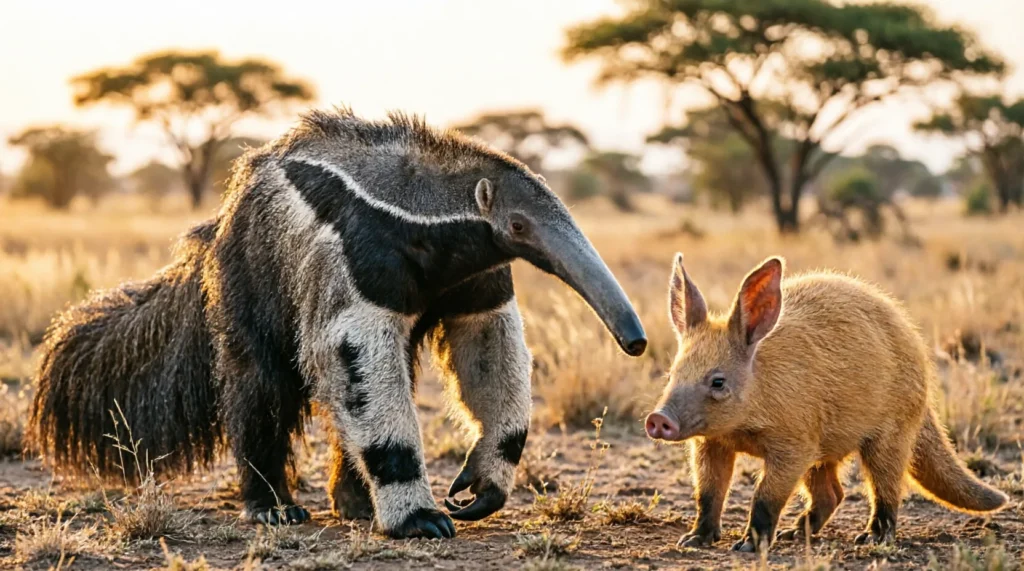
Quick answer: Anteaters and aardvarks are completely different animals from different continents and evolutionary families—anteaters live in Central and South America while aardvarks are native to Africa, and despite both eating ants and termites, they have distinct physical features, behaviors, and classifications.
Many people confuse anteaters and aardvarks because they both have long snouts, sticky tongues, and diets centered on ants and termites. However, these creatures evolved on separate continents and belong to entirely different biological orders. Understanding the difference between anteater and aardvark helps clarify one of nature’s most interesting examples of convergent evolution, where unrelated species develop similar traits to solve the same ecological challenges.
Quick Comparison Table
| Feature | Anteater | Aardvark |
|---|---|---|
| Scientific classification | Family Myrmecophagidae (order Pilosa) | Species Orycteropus afer (order Tubulidentata) |
| Native habitat | Central and South America | Sub-Saharan Africa |
| Size | 2-2.5 feet long (giant anteater), up to 88 lbs | 3.3-4.3 feet long, 88-143 lbs |
| Tail | Very bushy, almost as long as body | Thick at base, tapers toward end |
| Ears | Small, rounded | Very large, rabbit-like |
| Activity pattern | Diurnal or crepuscular | Nocturnal |
| Tongue length | Up to 2 feet long | Up to 12 inches long |
| Claws | Massive, curved front claws for tearing mounds | Strong claws for digging |
| Body covering | Coarse fur with distinctive black/white markings | Sparse hair, thick grayish-brown skin |
| Teeth | No teeth at all | 20-28 teeth with unique tubular structure |
What Is an Anteater?
Anteaters are mammals native to the tropical forests and grasslands of Central and South America. According to Anteater, there are four species in the anteater family: the giant anteater, the silky anteater, and two species of tamandua (northern and southern). These fascinating creatures have evolved specialized features that make them expert ant and termite hunters.
The giant anteater is the most recognizable species, with its distinctive black and white coloration and enormous bushy tail. These animals can grow up to 7 feet long including their tail and weigh as much as 88 pounds. Their most remarkable feature is their tongue, which can extend up to 2 feet long and flicks in and out 150 times per minute to lap up insects.
Anteaters have no teeth whatsoever. Instead, they rely on their powerful front claws to rip open termite mounds and ant nests, then use their sticky, saliva-coated tongues to extract the insects. Their stomach has specialized folds that help grind up the insects, compensating for the lack of teeth.
Real-world example: I once reviewed a children’s educational book that described “the anteater of Africa”—a glaring error that would confuse young readers about basic geography and biology. The correction was simple but crucial: anteaters are exclusively New World animals found in the Americas.
What Is an Aardvark?
Aardvarks are nocturnal mammals found throughout sub-Saharan Africa. The name “aardvark” comes from Afrikaans and Dutch, meaning “earth pig” or “ground pig,” which describes their pig-like snout and burrowing behavior. Unlike anteaters, aardvarks represent their own unique order (Tubulidentata) with no close living relatives.
Aardvarks are larger and more robust than most people expect, weighing between 88 and 143 pounds and measuring 3.3 to 4.3 feet in body length. They have thick, tough skin that protects them from insect bites, sparse hair covering their bodies, and remarkably large, rabbit-like ears that help them detect predators in the dark.
What makes aardvarks particularly interesting is their dentition. They possess 20-28 teeth with a unique tubular structure that lacks enamel—a feature found in no other mammal. These teeth grow continuously throughout their lives, wearing down from their abrasive diet of ants and termites.
Real-world example: In a travel blog post I edited last year, the author wrote about “spotting an aardvark in Costa Rica”—geographically impossible since aardvarks exist only in Africa. This mistake would have misled travelers and damaged the blog’s credibility. The fix required changing the location to South Africa or removing the anecdote entirely.
Key Differences Between Anteater and Aardvark
Geographic Distribution
The most fundamental difference is location. Anteaters inhabit the warm regions of Central and South America, from Honduras down through Argentina. Aardvarks, meanwhile, roam the savannas, grasslands, and woodlands of sub-Saharan Africa. These animals never encounter each other in the wild—they’re separated by an entire ocean.
Physical Characteristics
While both animals have elongated snouts, the details differ significantly. Anteaters have a tubular snout with a tiny mouth opening at the end, while aardvarks have a more pig-like snout. Aardvarks sport enormous ears that stand upright like a rabbit’s, whereas anteaters have small, rounded ears. The tail is another dead giveaway: anteaters have spectacularly bushy tails that can be nearly as long as their bodies, while aardvark tails are thick at the base and taper to a point.
Activity Patterns
Anteaters are generally active during the day or at dawn and dusk (diurnal or crepuscular), though they may adjust their schedule based on temperature and food availability. Aardvarks are strictly nocturnal, emerging after sunset to forage and returning to their burrows before dawn. This behavioral difference reflects their adaptation to different predator pressures and climate conditions.
Anatomical Features
Perhaps the most striking anatomical difference is that anteaters have zero teeth, while aardvarks have 20-28 tubular teeth. Anteaters compensate with an incredibly long tongue (up to 2 feet) and a specialized stomach for grinding insects. Aardvarks have shorter tongues (about 12 inches) but use their teeth to help process food.
Real-world example: A student’s biology report I reviewed stated “both animals use their teeth to crush termites”—incorrect for anteaters, which have no teeth at all. The student had confused the two species’ feeding mechanisms. The corrected version explained that anteaters swallow insects whole while aardvarks do use their unique teeth for chewing.
How to Remember the Difference
Here’s a simple memory trick that works: Anteaters live in the Americas, while Aardvarks live in Africa. Both start with “A,” but the second letter tells the story—”nteater” contains “America” if you think about it, and “ardvark” clearly sounds more African.
Another approach: Think of the aardvark’s enormous ears. Only African animals need such huge ears to detect predators across the vast savanna. The anteater’s bushy tail is equally distinctive—no African mammal has a tail quite that spectacular.
You can also remember that aardvarks are the “odd ones out” evolutionarily. They’re the only members of their entire order, making them truly unique. Anteaters, while specialized, belong to a family with multiple species and have closer relatives (sloths) in the same order.
Common Mistakes and Misconceptions
The “Ant-Eater” Generalization
One of the most persistent errors is using “anteater” as a generic term for any ant-eating mammal. This is taxonomically incorrect. While pangolins (found in Africa and Asia), echidnas (Australia), and numbats (Australia) also eat ants and termites, they are not anteaters. Each represents a separate evolutionary lineage that independently developed ant-eating adaptations.
Assuming They’re Closely Related
Because anteaters and aardvarks look somewhat similar and share a diet, many assume they’re closely related cousins. In reality, they’re a textbook example of convergent evolution—unrelated species developing similar features because they face similar environmental challenges. According to Difference, this phenomenon occurs when different lineages independently evolve similar traits to adapt to comparable ecological niches.
Confusing Their Defenses
People often think both animals rely on the same defense mechanisms. In fact, anteaters can stand on their hind legs and slash with their massive front claws, while aardvarks primarily dig rapidly to escape underground or use their thick skin as protection. Aardvarks are also surprisingly fast runners when threatened.
Misunderstanding Their Conservation Status
Both animals face habitat loss, but their situations differ. Giant anteaters are classified as vulnerable, with populations declining due to habitat destruction and hunting. Aardvarks are currently listed as least concern, though some regional populations are decreasing. Treating them as having identical conservation needs overlooks important ecological differences.
Frequently Asked Questions
Can anteaters and aardvarks interbreed?
No, anteaters and aardvarks cannot interbreed because they’re not just different species—they’re from entirely different orders of mammals separated by millions of years of evolution and an ocean.
Which animal has the longer tongue, an anteater or an aardvark?
The giant anteater has a significantly longer tongue, extending up to 2 feet, compared to the aardvark’s tongue which reaches about 12 inches in length.
Are anteaters and aardvarks endangered?
Giant anteaters are classified as vulnerable with declining populations, while aardvarks are currently listed as least concern, though local populations face pressure from habitat loss and hunting in some regions.
Do both animals only eat ants and termites?
While ants and termites make up the primary diet of both species, aardvarks will occasionally eat other insects and even fruits like wild cucumbers, whereas anteaters are more specialized and almost exclusively consume ants and termites.

Kevin Sanchez holds a Master’s degree in English Linguistics from the University of California, where he cultivated a deep appreciation for the intricacies of language. With over 10 years of experience in the field, Kevin specializes in the nuances of English spelling, particularly the evolution of spelling conventions over time. His fascination with how English words have transformed through cultural and technological influences led him to become a prominent voice at SpellRightDaily. Kevin produces content focused on historical spelling variations and their contemporary implications, offering readers insightful comparisons of British and American English. Beyond this, Kevin has a keen interest in educating readers about the rules that govern standard spelling and the exceptions that often lead to confusion. His articles frequently feature tips for mastering complex spelling patterns and understanding the etymology of perplexing words. Kevin’s dedication to clarity and accessibility makes his contributions invaluable to both casual readers and English language professionals.